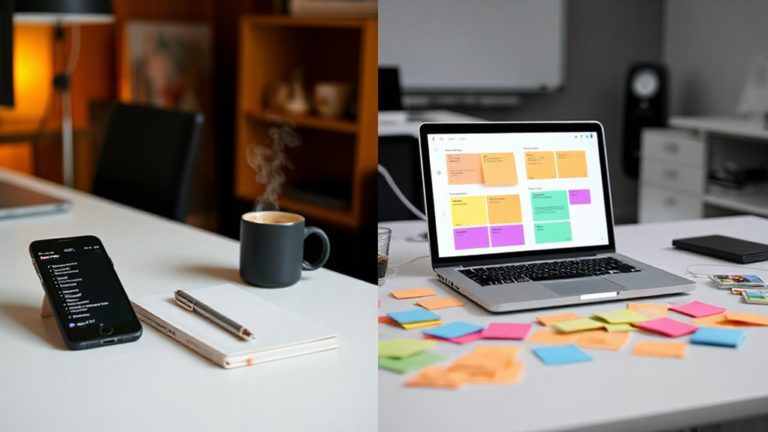
In the domain of computing and human cognition alike, context switching represents a hidden tax on productivity that few adequately measure or manage. Within computer systems, this phenomenon occurs when the CPU stops one process, saves its state into the Process Control Block, and loads another process’s state to resume execution. This mechanism enables multitasking operating systems to create the illusion that multiple programs run simultaneously, though each switch consumes valuable computational resources measured in nanoseconds that accumulate markedly under high loads.
Context switching extracts a hidden tax on productivity—measured in nanoseconds for computers, but costly minutes for human attention and focus.
The triggers for context switching mirror patterns seen in human work environments. High-priority processes entering the ready state resemble urgent emails demanding immediate attention. Timer interrupts parallel scheduled meetings that fracture concentration. System calls reflect the constant toggling between applications, browsers, and communication platforms that define modern knowledge work. While schedulers like Round Robin and Linux’s Completely Fair Scheduler optimize these shifts in computing, humans lack comparable internal algorithms to manage their own attention shifts efficiently. AI meeting tools can help by reducing unnecessary switches through automated agenda and reminder features that keep participants focused on meeting preparation.
The performance costs extend beyond mere time lost. In systems, excessive context switching reduces overall throughput as the CPU dedicates cycles to saving registers and program counters rather than executing useful work. For humans, the impact proves even more severe. Attention residue from prior tasks impairs focus on new activities, requiring minutes to fully re-engage rather than the CPU’s nanoseconds. This cognitive overhead increases errors, depletes mental energy, and diminishes creativity. Frequent interruptions from Slack messages, emails, and meetings prioritize reactive short tasks over deep, meaningful work. The dispatcher component performs the low-level actions that actually transfer CPU control from one process to another during these transitions. When a single CPU core without hyperthreading can execute only one thread at a time, the necessity for efficient context switching becomes paramount.
Today’s experiment offers a simple yet revealing exercise: count every context switch throughout the workday. Track each shift between projects, applications, conversations, and interruptions. The resulting tally often surprises participants, revealing dozens or even hundreds of transitions that fragment attention and dilute effectiveness. This awareness becomes the foundation for mitigation. Strategies include dedicating focused blocks to single projects, minimizing communication distractions, and employing collaboration tools that reduce application switching. By measuring what remains invisible, individuals gain leverage to reclaim their cognitive resources and direct them toward work that genuinely matters.