Software development stands at a crossroads where traditional craftsmanship meets industrial-scale production, and the shift demands a fundamental rethinking of quality standards. Engineers accustomed to taking pride in meticulously crafted code now face a psychological shift as AI-assisted workflows enable scaled production that fundamentally changes what “good enough” means. Intelligent automation increasingly handles routine implementation details, allowing engineers to focus on higher-level design and review processes.
AI-assisted workflows fundamentally redefine what “good enough” means, forcing engineers to abandon artisanal pride for industrial-scale production values.
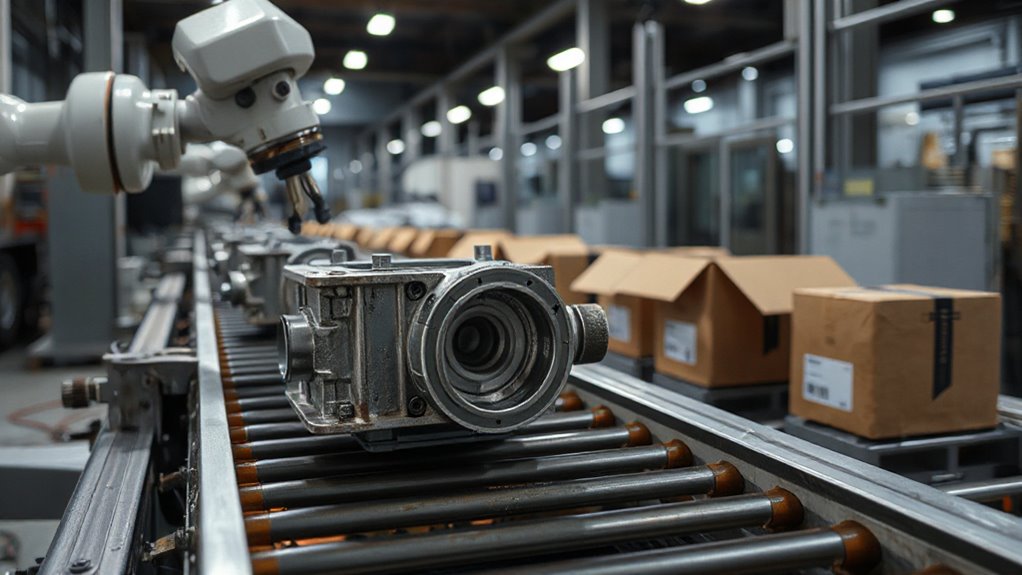
The manufacturing sector offers instructive parallels. Garment factories have long categorized imperfections into critical, major, and minor defects, recognizing that perfection remains unattainable at industrial scale. Quality control occurs midway through production lines rather than at the end, with measurements against specifications guiding adjustments. When entire shipments face rejection for dangerous materials, the issue stems from critical flaws, not the minor imperfections inherent in processes involving 94 sewers per line. This acceptance of categorized imperfection enables repetitive processes that consistently deliver quality, even at lower price points. Whole-garment knitting machines can program and produce complex outputs in seven minutes, replacing multiple human workers while improving exactness and precision.
Software development now mirrors this reality. Tests remain imperfect while monitoring stays incomplete, yet skilled engineers review code for confidence rather than perfection. The traditional model allocated 90% of time to features while creating technical debt, with only 10% invested in easing future work. AI-assisted workflows flip this equation by handling code from decomposed tasks, with humans reviewing pull requests iteratively. Trust in plans eliminates the need to watch every code line, allowing features to ship without direct coding. Just as manufacturing operations execute in linear paths based on defined sequences, modern development workflows proceed through systematic review stages rather than requiring exhaustive examination of every implementation detail.
This transformation requires new confidence methods. Write-only code demands focus on interfaces, invariants, and failure modes rather than line-by-line scrutiny. Each engineering unit compounds to ease subsequent work, prioritizing planning over coding. The review step captures learnings for cycles, enabling features without traditional manual development that proves too slow for current production demands.
The strategic shift involves embracing imperfections through tooling investment. Review agents, pattern documentation, and test generators become core infrastructure, turning what appears as blind shipping into competitive advantage. Shaping intent exceeds shaping implementation in importance. While software development rewires internally, external inputs and outputs remain unchanged. The difference lies in accepting that polishing consumes resources better invested in shipping functional value, trusting systematic quality controls over artisanal perfection.