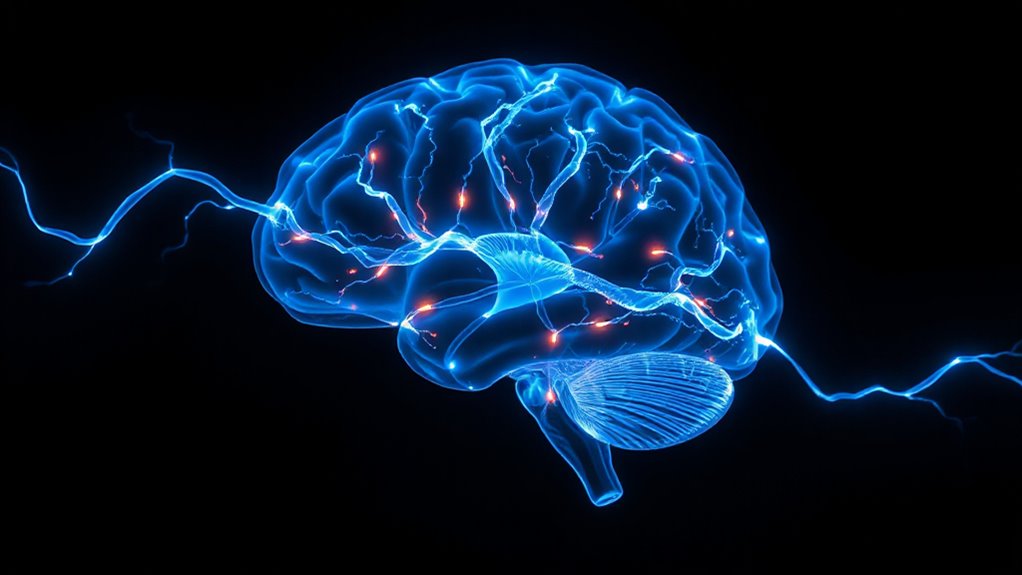
The human brain begins making choices long before conscious awareness catches up, a phenomenon that challenges traditional notions of deliberate decision-making. Research reveals that brain signals can predict decision outcomes up to seven seconds before people become aware of their choices. Sophisticated programs trained on frontopolar cortex micropatterns successfully predict decisions above chance levels, suggesting that unconscious preparation occurs well ahead of the moment when individuals believe they have made up their minds.
Your brain decides up to seven seconds before you consciously realize you’ve made a choice.
This unconscious processing appears to accumulate evidence at a reduced rate and variability compared to conscious deliberation. When unconscious information from the first half of experimental trials combines with conscious data, decision accuracy improves measurably. However, this accuracy boost comes without increased confidence, indicating that people possess poor metacognitive awareness of their unconscious processing capabilities. Curiously, unconscious information proves usable only when conscious decision-relevant data is also present.
Brain imaging studies provide compelling evidence for these hidden processes. Visual and prefrontal cortices reactivate unconsciously during distractor tasks, and the amount of reactivation predicts improved decisions in real-world scenarios like selecting the best car or apartment. This neural activity offers the first tangible clues about brain mechanisms underlying effective problem-solving without conscious attention.
Despite these findings, the superiority of unconscious thought remains debated. A thorough meta-analysis examining 888 subjects found no convincing evidence that unconscious deliberation outperforms conscious reasoning. While a modest trend favored unconscious thought, high heterogeneity across studies and smaller sample sizes producing larger effect sizes raised methodological concerns.
Replication studies confirmed that distraction tasks like anagrams yielded no meaningful difference in decision quality compared to direct deliberation, with approximately sixty percent of participants consistently choosing the best option regardless of thought mode.
These discoveries carry practical implications. Understanding that decisions involve both conscious and unconscious components can help individuals approach complex choices more effectively. Rather than forcing immediate conclusions, allowing periods of distraction may enable beneficial unconscious processing, particularly for complicated decisions involving multiple attributes and considerations. New research also suggests that the lateral prefrontal cortex helps suppress irrelevant information and may support the unconscious filtering that aids decision-making.