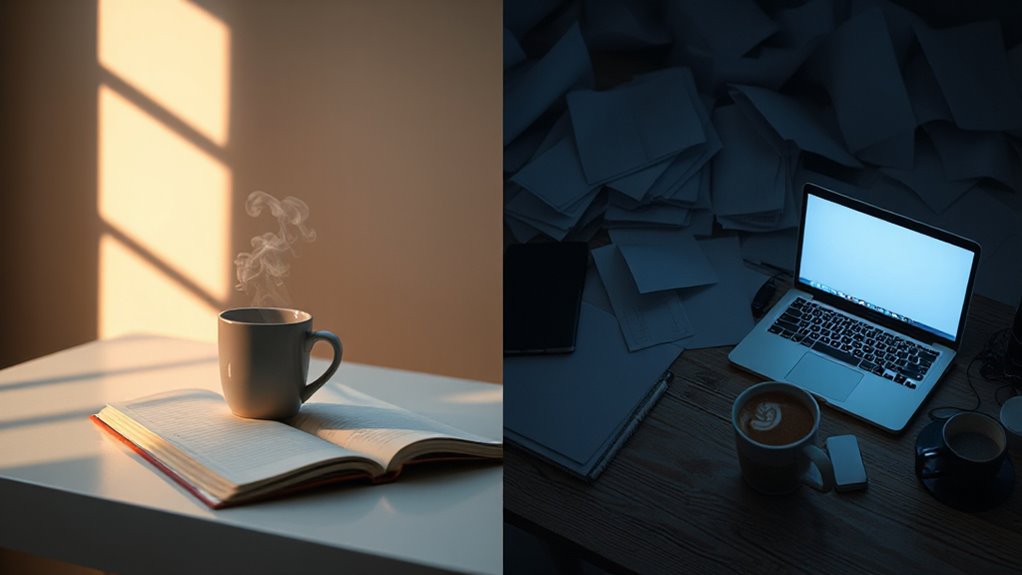
In today’s fast-paced work environment, professionals face a persistent tension between the pressure to deliver results quickly and the need for mental space that creativity requires. Research reveals that 80% of workers in the United States and United Kingdom experience mounting pressure to prioritize productivity over creativity, even though creative activities occupy merely 25% of their work time. This cultural emphasis on efficiency creates a fundamental paradox: stress suppresses the very creative capacity that organizations need for competitive advantage, with 90% of business leaders acknowledging creativity as essential for market success.
The relationship between relaxation and creativity proves more nuanced than conventional wisdom suggests. Studies show that employees actually perceive higher creativity when experiencing difficulty disconnecting from work rather than during complete detachment. However, the timing matters considerably—workers report peak creativity levels approximately two weeks after returning from vacation, suggesting that recovery’s benefits extend beyond the immediate period. Additionally, mastery experiences, which provide opportunities to develop skills and competence, drive meaningful differences in creative output between individuals.
Understanding ideal work patterns can help reconcile the tension between deadlines and creative needs. Research consensus indicates that two to four hours of deep creative work daily represents the ideal range for sustained output. Performance peaks at specific times: 46% of leaders feel most creative on Tuesdays, while 37% experience heightened creativity during Wednesday afternoons. Recognizing these patterns allows professionals to schedule demanding creative tasks during natural high-energy periods while reserving routine work for less optimal times.
Practical strategies can bridge the gap between relaxation requirements and deadline pressures. Task variety reduces cognitive fixation and promotes both divergent and convergent thinking, making it easier to maintain creative flow under time constraints. Surprisingly, 56% of respondents identified daydreaming as a substantial creativity booster that enables more efficient completion of challenging tasks. Organizations that restrict creative expression may maintain short-term efficiency but sacrifice long-term adaptive capacity. By intentionally protecting time for mental recovery while strategically scheduling creative work, professionals can honor both productivity demands and the conditions that fuel genuine innovation. A thoughtful AI-enabled workflow can automate routine tasks and save time for creative work, boosting productivity by enabling employees to complete routine work 40% faster and reclaim hours for recovery and deep thinking.