How effectively can organizations balance productivity gains with employee trust in an era where workplace monitoring has become the norm rather than the exception? With 73% of employers monitoring remote workers and 75% tracking office employees, workplace surveillance has reached unprecedented levels across virtually all employment settings.
Modern workplace surveillance has reached unprecedented levels, with three-quarters of employers now monitoring their workforce across all employment settings.
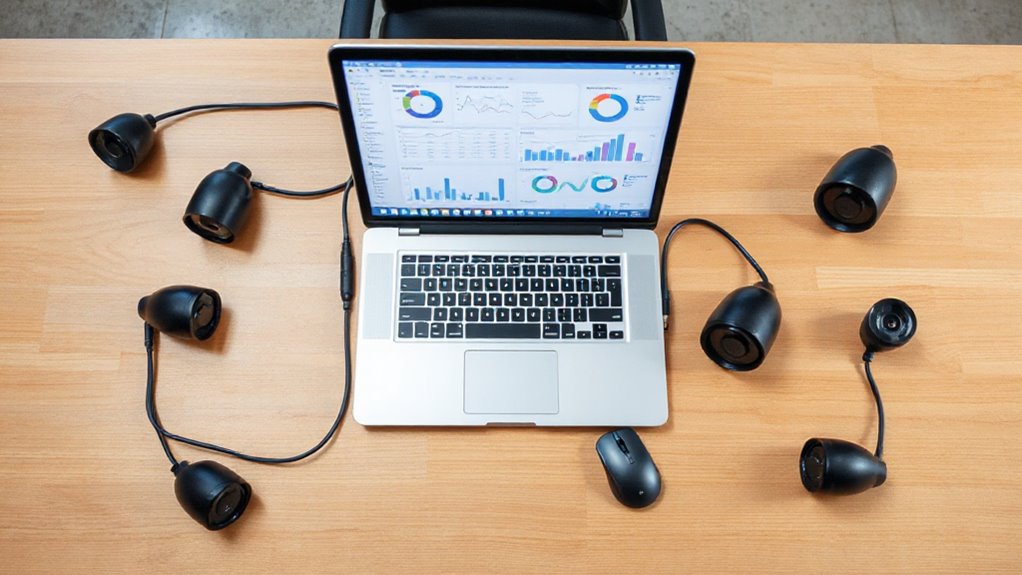
The scope of modern monitoring extends far beyond simple time tracking. While 96% of companies use time-tracking software, employers now deploy sophisticated tools that capture screenshots, monitor chat activity, and enable remote device access. Eighty-six percent of monitoring platforms offer real-time activity tracking, and 69% of employers utilize video surveillance, creating all-encompassing oversight systems that track employee behavior throughout the workday. These tools contribute to measuring labor productivity by analyzing output relative to time spent.
Employees are acutely aware of this scrutiny, with 80% feeling tracked to at least a moderate degree. Nearly a quarter experience high levels of monitoring, including location tracking and webcam recording. These perceptions carry significant implications, as 72% believe monitoring could invade personal privacy and 71% worry about negative impacts on workplace trust. Notably, most employees are not fundamentally opposed to tracking but express frustration with the lack of transparency surrounding monitoring practices.
Despite these concerns, organizations report substantial benefits from monitoring initiatives. Eighty-one percent of companies observe increased work output after implementation, while 62% note improved employee accountability. Managers consistently report that remote monitoring enhances team productivity and helps identify workflow bottlenecks, contributing to more accurate payroll and billing processes. The advertising and marketing industry exemplifies this trend, with 83% adoption of monitoring software demonstrating widespread acceptance across creative sectors. Regular productivity measurement also helps organizations benchmark their performance against industry standards.
Advanced artificial intelligence technologies are revolutionizing monitoring capabilities beyond basic surveillance. AI systems can predict performance levels, categorize applications as productive or unproductive, and detect burnout symptoms with 92% accuracy. These sophisticated tools also identify workplace toxicity through sentiment analysis with 87% precision, offering organizations unprecedented insights into employee engagement and well-being.
The rapid expansion of monitoring technology, driven by remote and hybrid work models, has created a market projected to reach $12.5 billion by 2032. However, successful implementation requires thoughtful consideration of employee perspectives and privacy concerns. Organizations that transparently communicate monitoring purposes, focus on performance rather than personal data, and establish clear boundaries can harness productivity benefits while maintaining employee trust and engagement in an increasingly watched workplace environment.