Run Appliances Automatically and Reclaim Hours Every Day
Modern households can reclaim a surprising number of hours each week simply by allowing appliances to operate automatically in the background.
Scheduling dishwashers and washing machines to run during late-night or early-morning hours eliminates the need for constant supervision.
Setting dishwashers and washing machines to run overnight frees households from the burden of constant appliance supervision.
Built-in timers can activate these appliances during off-peak windows, such as before 3 p.m. or after 7 p.m. on weekdays.
Smart meters further support this approach by identifying low-demand periods with precision.
Automating appliance usage during utility company incentive periods also reduces energy costs simultaneously.
Households gain both time and financial savings without requiring additional daily effort. Cable boxes, which average 16 watts of standby power, cost households roughly $19 per year simply by remaining plugged in and idle.
Pool pumps, for example, can often be reduced to 4 hours of daily operation without compromising water quality, saving significant energy while the pump runs entirely unattended.
This background automation also improves consistency and reduces manual oversight through workflow automation that manages schedules and alerts.
The Best Appliances to Run While You Do Other Things
Automating appliance schedules is only part of the equation — selecting the right appliances to run unsupervised makes an equally significant difference. Many households report reclaiming hours weekly by shifting chores to background devices and increasing productivity.
Dishwashers, washing machines, and tumble dryers handle laundry and kitchen cleanup without requiring constant attention.
Smart refrigerators monitor their own efficiency, while DC-powered models suit off-grid households particularly well.
Slow cookers prepare meals steadily over hours, demanding no supervision.
Heat pump water heaters operate quietly in the background, heating water only when needed.
Each appliance listed addresses a specific household task, freeing individuals to focus on meaningful work rather than routine chores that consume disproportionate amounts of daily time. Washing machines, dishwashers, and tumble dryers alone account for 14% of a typical energy bill, making efficient and well-timed use of these appliances a straightforward way to reduce household running costs. Washing clothes in cold water rather than hot is one of the simplest adjustments available, cutting the energy demand of each cycle without affecting cleaning performance.
Timer and Delay-Start Settings That Automate Every Load
Timer and delay-start settings transform ordinary appliances into self-managing tools that operate around a household’s schedule rather than demanding constant attention.
Smart appliances now adapt to your life, running on your schedule without demanding your constant presence.
Whirlpool ranges allow users to enter a delay start time through a simple keypad sequence, while Samsung wall ovens support timers up to nearly 24 hours.
GE ovens use mechanical dials with audible feedback, automatically beginning and ending baking cycles without manual intervention. Before any delay cycle can be programmed, the Range clock must be set to the correct time of day.
Redmond multicookers extend this flexibility further, supporting delays from 10 minutes to a full day.
Microwaves, meanwhile, accommodate preprogrammed delays approaching 100 minutes. Stand Time and Delay Start cannot be programmed before automatic cooking functions like Sensor Reheat, Popcorn, or Turbo Defrost.
These automated features can help reclaim time otherwise lost to household tasks by reducing active monitoring and idle waiting lost working hours.
Run Appliances During Off-Peak Hours and Lower Your Bill Too
Delay-start features do more than simply free up time—they also open the door to meaningful savings when paired with a utility’s time-of-use pricing plan. Peak electricity hours typically fall between 4 PM and 9 PM on weekdays, when rates run 40–60% higher in some regions.
Scheduling dishwashers, washing machines, and EV chargers to run overnight, often between 9 PM and 7 AM, captures noticeably lower rates. Water heaters and pool pumps respond equally well to off-peak scheduling. Improved focus from planning appliance use can help households consistently shift loads to cheaper hours.
Enrolling in a time-of-use plan usually requires an advanced meter, so confirming eligibility with the utility company is a practical first step. Switching is allowed up to once a year, so comparing available rate plans before committing helps ensure the best fit for a household’s energy habits. Weekends and holidays are commonly designated as off-peak periods, offering another window to run energy-intensive appliances at lower rates.
Daily Appliance Routines That Run Themselves Without Reminders
Once a household’s appliances are properly configured, daily routines can certainly run themselves without a single reminder or manual prompt.
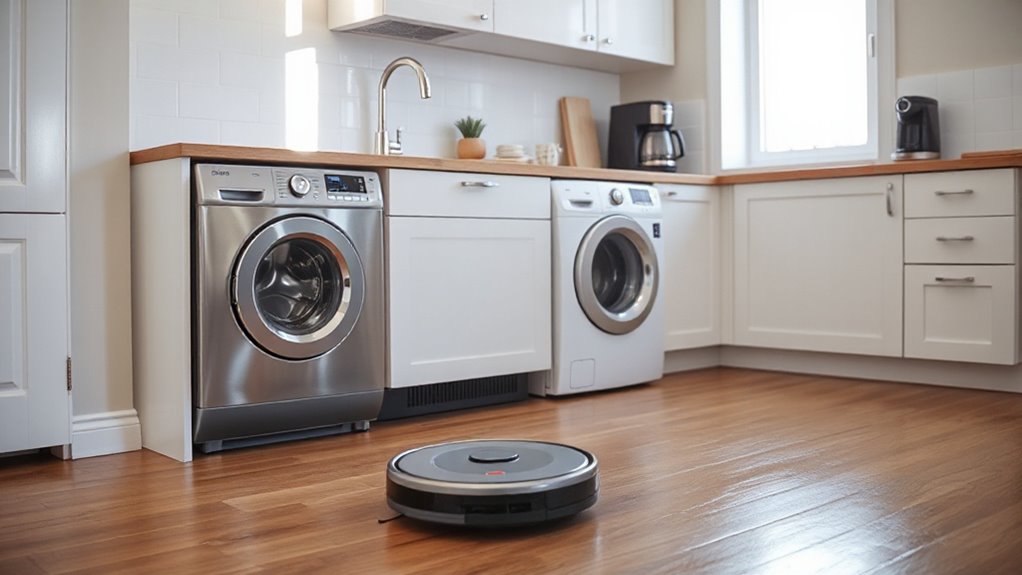
Robot vacuums map rooms once, then manage cleaning zones autonomously.
Dishwashers combine auto-door and night modes to guarantee an empty unit every morning.
Washers using finish-by scheduling ensure laundry concludes precisely when needed.
Smart plugs run indefinite schedules for lamps, fans, and coffee makers without daily input.
Internal sensors trigger self-cleaning cycles automatically after each use, preventing mold and residue buildup secretly.
Dirty coils left unaddressed can increase power consumption by up to 15% over time, silently raising electricity bills before any visible problem appears.
Together, these systems shift appliance management from active daily effort into quiet, reliable background operation. Across a typical week, two well-chosen high-ROI appliances can reclaim a median 3.9 hours of household time.
AI platforms often integrate with home systems to automate routines and analyze usage patterns for efficiency gains, including document processing that helps interpret device logs and maintenance alerts.
Related Posts