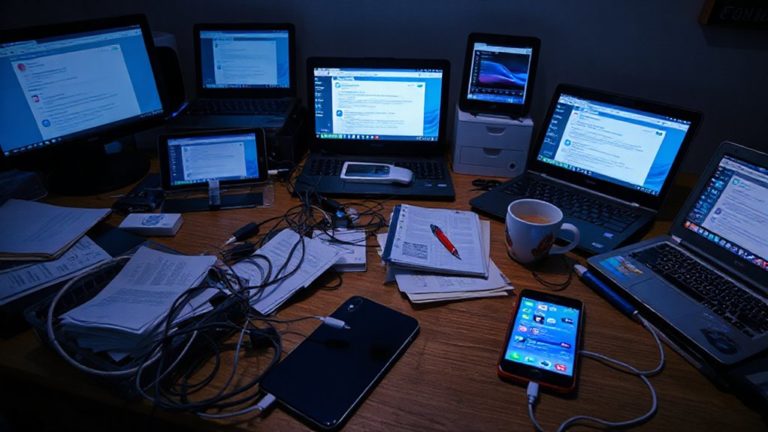







Stop Letting Meeting Overload Kill Your Deep Focus
For knowledge workers steering today’s meeting-saturated workplace, deep focus has become increasingly difficult to protect. Atlassian’s survey of 5,000 workers across four continents ranked meetings as the single greatest productivity barrier. Microsoft’s 2023 Work Trend Index confirmed the same finding.
Meanwhile, 78% of workers report that meeting volume prevents them from finishing meaningful work, and 72% of meetings never achieve their stated purpose. These numbers reflect a systemic problem, not isolated frustration. Companies with strong communication see measurable gains in productivity and fewer misunderstandings.
Recognizing meeting overload as a structural threat, rather than a minor inconvenience, is the essential first step toward reclaiming the focused time that complex work genuinely demands. In fact, purposeless meetings are the single biggest contributor to meeting fatigue, affecting nearly half of all full-time managers and employees surveyed across 15 countries. Compounding this burden, 76% of respondents report feeling drained on days filled with heavy meeting schedules, underscoring how deeply this pattern erodes both energy and output.
How a Broken Calendar Steals Hours You’ll Never Get Back
A calendar that looks busy is not the same as a calendar that works.
Scattered gaps of 15 to 45 minutes between meetings appear available but rarely support meaningful work.
Short gaps between meetings feel productive but vanish before meaningful work can begin.
Complex thinking, planning, and problem-solving all require sustained concentration that fragmented schedules simply cannot provide. The brain’s ability to block interruptions depends on prefrontal inhibition to suppress irrelevant inputs and preserve focus.
Research confirms knowledge workers average only about 1.8 hours of uninterrupted focus daily, and calendar clutter compresses that further.
Important work then migrates to early mornings or weekends by necessity.
Knowledge workers spend 60% of their time on work about work, including meetings, coordination, and tool switching, leaving remarkably little room for the skilled output they were actually hired to produce.
Recognizing this pattern is the first step toward fixing it, because reclaiming productive time starts with understanding exactly how it disappears. Each interruption during the workday can demand up to 20 minutes to fully restore the level of concentration that deep work requires.
Replace Status Meetings With Async Updates That Actually Work
Status meetings consume calendar space that most teams cannot afford to lose. Replacing them with structured async updates preserves focus time while keeping everyone informed.
Effective updates include completed work, next steps with clear owners, blockers requiring input, and specific questions the team can answer independently. Using a centralized, searchable workspace also reduces scattered emails and keeps context intact.
Posting updates on a fixed cadence, in a shared and searchable workspace, keeps information visible without scheduling another meeting.
Research supports this shift, as eight in ten workers report their meetings could have been handled asynchronously.
Reserving live time for real decisions rather than routine reporting is a practical and sustainable path forward. Async updates also create a searchable written record, giving teams a reliable reference that status meetings rarely produce. Meetings that only transmit status information are the clearest candidates for async replacement.
Protect Focus Blocks Before Interruptions Fragment Your Deep Work
Protecting focus blocks requires the same deliberate intent that professionals apply to any other high-priority commitment.
Scheduling one or two substantial focus blocks early in the day, before meetings accumulate, preserves the uninterrupted stretches that deep work demands.
Anchoring focus blocks to the morning hours secures deep work time before the day’s interruptions have a chance to accumulate.
Research confirms that meeting-heavy days reduce both anticipated productivity and positive affect, while frequent interruptions force costly cognitive resets, with recovery estimates reaching nearly 23 minutes per disruption.
Treating focus blocks as protected calendar assets rather than leftover time changes the dynamic entirely.
When meetings cluster around focus time instead of inside it, sustained attention becomes achievable rather than accidental.
Consistent application of strategies like time-blocking and reducing digital distractions can rapidly improve sustained attention and make those focus blocks more productive.
Cut the Switching Costs That Meeting-Heavy Days Create
Beyond meeting volume itself, the hidden toll of switching costs quietly erodes whatever productive time remains.
Knowledge workers toggle between applications nearly 1,200 times daily, losing close to four hours weekly just reorienting after each switch.
Every meeting compounds this problem by introducing at least two interruptions: the entry and the exit.
Refocusing afterward can require 23 minutes or more.
Practical recovery starts with grouping meetings into tighter windows, limiting unnecessary tool switching, and treating interruptions as a genuine capacity issue. Sustained heavy multitasking can produce a temporary IQ reduction of up to 10 points, a cognitive impairment reported as greater than losing a full night of sleep.
The average employee now navigates 18 applications per day, a volume that correlates directly with coordination drag and deepening context-switching costs.
Small structural adjustments, made consistently, preserve the sustained attention that complex analytical work genuinely requires. Scheduled email checks also reduce digital interruptions and help maintain focus.