






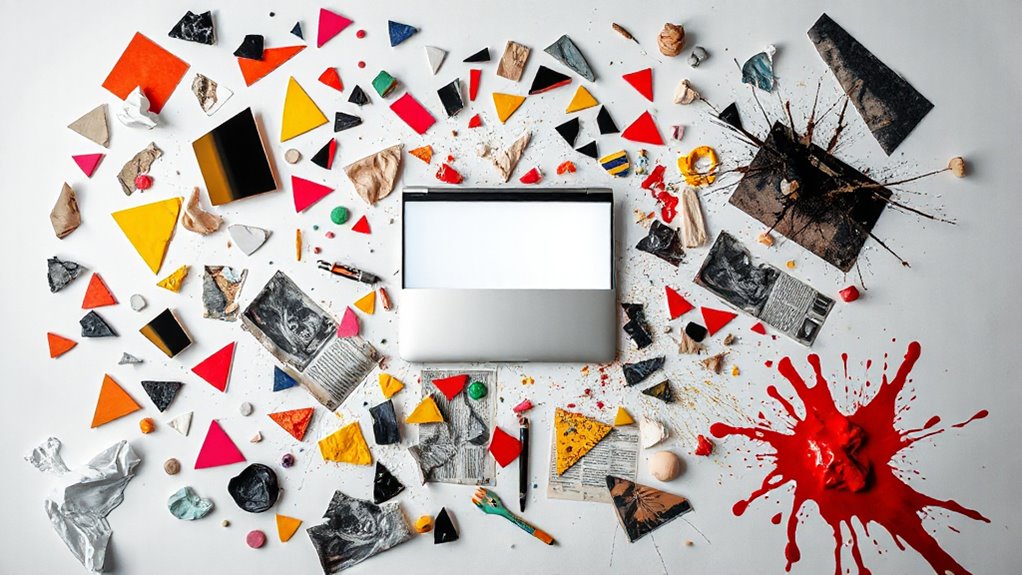
Pablo Picasso’s extraordinary legacy rests not on rejection of tradition, but on his masterful absorption and transformation of it. He studied Renaissance single-point perspective before shattering it through Cubism, revived Baroque trompe-l’œil effects with collage materials, and reinterpreted canonical works by Delacroix, Manet, and Rembrandt through radical new lenses. His approach demonstrates that true originality emerges from deep engagement with the past, not ignorance of it.
True originality emerges from deep engagement with the past, not ignorance of it—innovation requires transformation, not rejection.
The co-inventor of Cubism with Georges Braque fragmented forms and represented multiple perspectives on a single plane, drawing inspiration from African masks to challenge traditional aesthetic principles. This revolutionary vision extended across media as Picasso mastered etching, aquatint, lithography, and linocut, pioneering the reduction linocut technique in 1962. He reshaped ceramics into sculptural forms, explored theatrical design, and invented constructed sculpture, proving that innovation thrives through relentless medium exploration. At Madoura pottery studio in Vallauris, he drew from Greek vases and Iberian amphorae to reimagine ceramic traditions through modern formal experiments.
Picasso’s career trajectory reveals constant reinvention as essential to creative importance. He progressed from the Blue Period through the Rose Period to Cubism, transcending realism, abstraction, Neoclassicism, Surrealism, and Expressionism without remaining confined to any single movement. His precocious talent emerged during early years in Barcelona and Paris, where he absorbed influences and transformed them into a unique artistic language. He reworked motifs across multiple states, distilled images to their essence through deliberate subtraction, and deconstructed subjects like the bull by eliminating unnecessary elements. This approach demonstrates that originality requires both accumulation and reduction.
His technical innovations included inventing papier collé with newsprint and colored paper, incorporating tactile cloth and illusionistic wood grain, and using common house paint to blur boundaries between functional objects and fine art. He painted primarily from imagination or memory, avoiding models, and worked mostly at night under artificial light. These unconventional methods emerged from his willingness to question assumptions about materials and process.
Today’s creators face unprecedented pressure from algorithmic content and artificial intelligence. Picasso’s example offers a blueprint: absorb influences voraciously, experiment across disciplines, deconstruct established forms, and synthesize diverse resources with personal perspective. Originality demands ferocious engagement with tradition, technical mastery, and courage to fragment then reassemble the world according to one’s unique vision. AI can also boost creative productivity by reducing routine tasks and freeing time for higher-level experimentation, especially when teams track time savings and deployment outcomes.
Related Posts