The 40-Hour Workweek Standard: Where It Came From and Why It’s Questioned
How did the standard 40-hour workweek, a cornerstone of modern employment, become so deeply embedded in workplace culture? Its origins trace back to Industrial Revolution-era labor movements, when workers endured 80-100 hour weeks under brutal conditions.
Activists like Robert Owen championed the eight-hour day concept in 1817, though widespread adoption took decades. Henry Ford‘s 1926 implementation of the five-day, 40-hour week proved transformative, demonstrating that reduced hours actually boosted productivity and worker loyalty.
The 1938 Fair Labor Standards Act finally codified this standard into American law. However, this framework was designed for manufacturing labor, not today’s knowledge work. The National Productivity Council’s focus on innovation-led measures and circular economy principles shows how productivity thinking has evolved to include sustainability and waste reduction.
What Happens to Productivity After 50 Hours per Week?
The relationship between working hours and productive output follows a predictable pattern that defies the “more hours equals more results” assumption many organizations still embrace.
Research consistently demonstrates that productivity sharply declines after employees exceed 50-hour workweeks, with minimal output differences between those working 70 hours versus 50 hours.
Three critical consequences emerge beyond this threshold:
- Cognitive performance deteriorates as mental fatigue compromises decision-making quality in knowledge work
- Health risks escalate, including 33% higher stroke risk at 55+ hour workweeks
- Workforce turnover accelerates when employees seek better work-life balance elsewhere
The evidence suggests efficiency losses compound across entire teams. Prolonged stress also causes compromised immune function and other physiological harms that reduce employees’ resilience and recovery.
How Microsoft Japan and Three Other Companies Cut Hours and Increased Output
In August 2019, Microsoft Japan launched a bold experiment that would challenge conventional workplace wisdom: the company granted all 2,300 employees every Friday off with full pay for an entire month.
The results defied skeptics. Labor productivity surged 39.9% compared to the previous year, while electricity consumption dropped 23.1% and printing fell 58.7%. The company achieved these gains by capping meetings at 30 minutes and promoting remote collaboration through Microsoft Teams.
Iceland’s larger trial from 2015-2019, involving 2,500 workers, produced similar outcomes: productivity increased while employee well-being improved across stress, burnout, and work-life balance measures.
Many organizations have since adopted AI tools to automate scheduling and further boost meeting efficiency.
Build Your Work Schedule Around Deep Focus Blocks, Not Clock Time
Shifting from traditional time-based schedules to intentional deep focus blocks represents one of the most effective strategies knowledge workers can adopt to amplify their output and reclaim control over their workdays.
Deep focus blocks transform scattered workdays into intentional periods of high-impact productivity that knowledge workers can actually control.
Three strategies to implement deep focus blocks:
- Schedule 60–90 minute blocks during peak energy windows as non-negotiable calendar appointments, treating them like critical meetings while batching shallow work separately.
- Select one meaningful task per block to avoid context-switching penalties, which average 20 minutes of recovery time and drain mental energy markedly.
- End each block intentionally by noting completed work, rating focus on a 1–10 scale, and logging what helped or hindered concentration for continuous improvement.
Short, frequent breaks and simple mindfulness practices (like a 10-minute meditation) can boost attention and recovery between blocks, so experiment with Pomodoro-style intervals to find what fits your rhythm.
Match Cognitively Demanding Tasks to Your Peak Energy Hours
Knowledge workers consistently undermine their productivity by treating all hours as equal, scheduling complex analytical work during afternoon energy slumps and relegating routine tasks to their peak morning hours.
Research shows individuals possess only four to six hours of full cognitive energy daily for demanding work. Most people experience peak performance from late morning through early afternoon, making this window ideal for drafting new content, revising complex documentation, or tackling analytical challenges.
Reserve low-energy periods for routine tasks like email management and administrative work.
Understanding your chronotype—whether you’re a morning lark or evening owl—enables precise alignment of demanding tasks with personal peak performance windows.
Meditation and mindfulness can produce measurable attention improvements within days, so incorporating short practice sessions during peak periods can further enhance focus and productivity for sustained attention.
Track Completed Projects and Quality Instead of 40-Hour Attendance
Beyond optimizing individual work periods, organizations achieve better outcomes by measuring what truly matters: the projects delivered and their quality rather than the hours employees spend at their desks.
Success stems from measuring project outcomes and quality, not the time spent sitting in office chairs.
Three effective tracking approaches include:
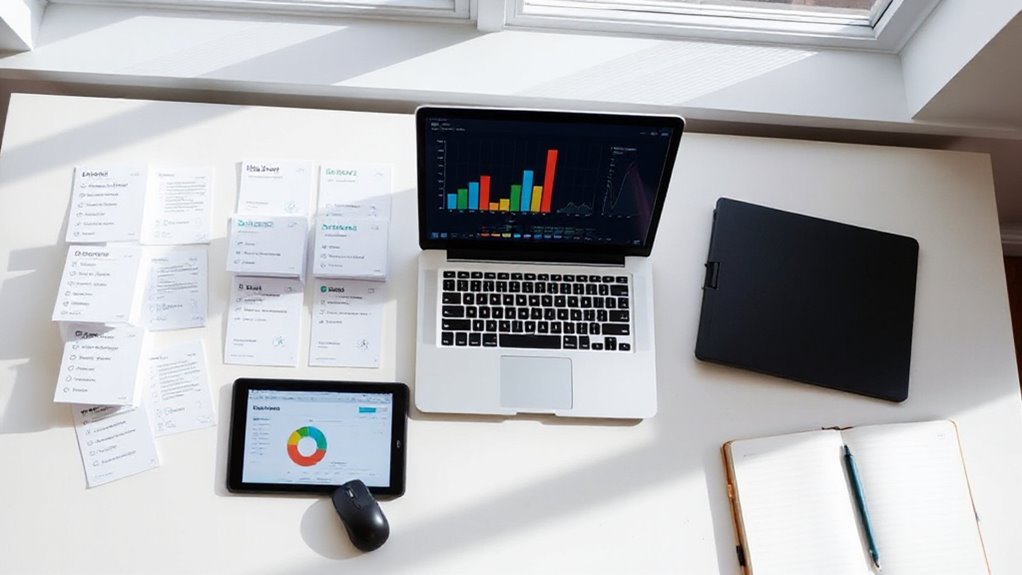
- Project progress dashboards that monitor task completion rates, deliverables, and quality checkpoints through real-time visualization tools
- Task-based productivity metrics that break work into tickets with due dates, measuring output against milestones rather than attendance
- Quality assessment reports evaluating completion rates, resource utilization, and budget accuracy to improve forecasting
This shift exposes true team capacity, prevents overload, and enhances profitability insights by focusing on meaningful results. Organizations can support this shift by implementing workflow management practices that include process mapping, automation, and performance monitoring to ensure alignment with business objectives.