







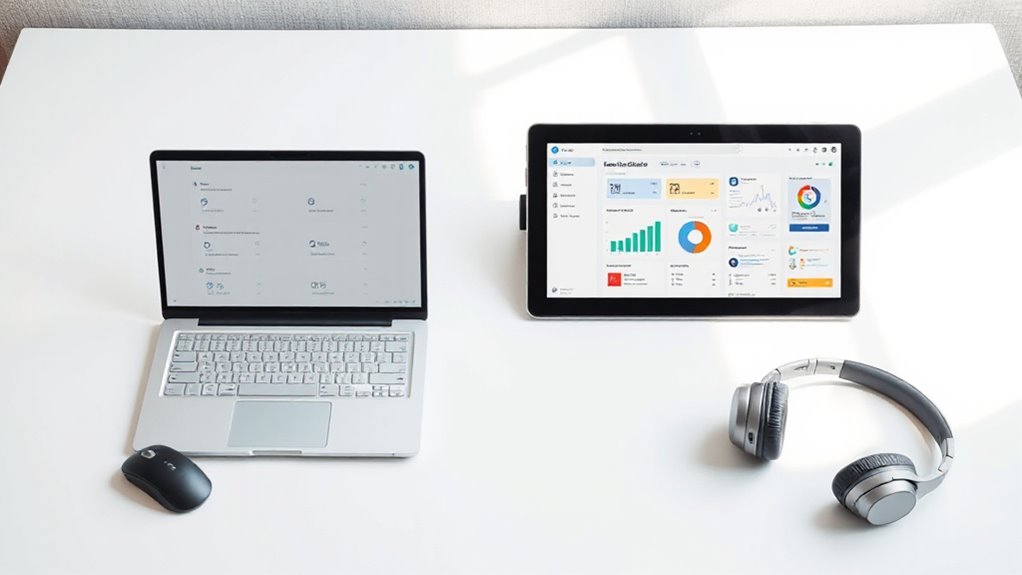
In the landscape of digital productivity, the choice between free and paid tools often determines whether users unleash their full potential or settle for basic functionality. For individual users managing personal tasks, free applications like Microsoft To Do and Todoist’s basic tier provide comprehensive coverage with essential features including lists, due dates, and calendar integration. These platforms prove sufficient for straightforward task management without requiring financial commitment.
Free productivity tools deliver essential features for personal task management, proving that basic functionality doesn’t require financial investment.
The transition to paid subscriptions becomes justified when users demand advanced capabilities. Todoist Pro at $4 monthly expands project limits from 5 to 300 while adding AI assistance and unlimited activity history. Similarly, ClickUp moves from free collaborative features to $5 per user monthly for automation tools that streamline repetitive workflows. The pricing threshold typically ranges between $5 and $10 monthly for most productivity applications, positioning premium features within reasonable reach for committed users.
Team collaboration scenarios often expose the limitations of free tiers most clearly. Trello restricts free workspaces to 10 boards before requiring a $5 per user monthly investment for unlimited capacity and premium Power-Ups. Notion’s free plan covers foundational needs but reserves enhanced team collaboration options for its $10 monthly tier. These constraints push organizations toward paid plans when coordination complexity increases beyond basic sharing. Organizations that adopt paid tiers often see measurable gains in efficiency through personalized tools.
Specialized productivity categories command higher price points reflecting their targeted value propositions. Sunsama charges $20 monthly for guided planning with time estimates and analytics, appealing specifically to individuals prone to overcommitment who benefit from mindful scheduling. ChatGPT Plus matches this premium tier with advanced AI capabilities, while Zapier Professional at $19.99 monthly unlocks sophisticated automation through multi-step workflows and premium application integrations.
The performance question ultimately depends on user requirements rather than inherent superiority. Free applications excel for individuals and small groups with standard needs, delivering reliable task management and basic collaboration without cost barriers. Paid tools outperform when advanced analytics, extensive integrations, or specialized features become productivity necessities rather than conveniences. However, the most powerful tools become barriers when system complexity conflicts with natural organizational tendencies, leading many users to abandon feature-rich subscriptions within weeks of signup. Corporate environments particularly value paid options like Microsoft To Do for Outlook integration and comprehensive team tracking that free alternatives cannot match at scale. Fhynix stands out with free natural-language AI that understands commands like scheduling appointments without requiring premium subscriptions for core scheduling features.
Related Posts