Why Phone Alerts Wreck Your Remote Focus
During a focused work session, a single phone alert can undo minutes of concentrated effort in an instant.
Research confirms that notifications disrupt attention the moment a sound, vibration, or visual cue appears.
Notifications shatter focus the instant a sound, buzz, or visual alert reaches your senses.
Remarkably, even awareness of an alert, without touching the device, measurably impairs performance.
Studies show notification-related distraction produces effects comparable to actively using the phone.
For remote workers especially, these interruptions fragment deep work blocks into short, low-focus intervals.
Because sustained concentration is essential for computer-based tasks requiring strong cognitive control, understanding how alerts hijack attention is the critical first step toward reclaiming a productive workday.
A study using the Stroop task found that cell phone notifications increased distraction regardless of phone ownership or task difficulty, while the mere presence of a phone did not produce the same effect.
Research involving brain activity measurements found that smartphone notification sounds produced slower overall responses compared to neutral control sounds, revealing a direct neurological cost to encountering alerts.
Implementing scheduled phone checks and other digital boundaries can substantially reduce these interruptions and help restore longer focus periods.
Remote Work Doesn’t Automatically Protect Your Focus
Knowing that phone alerts damage focus is a useful starting point, but many remote workers assume that leaving the office automatically solves the interruption problem. Research tells a different story.
A two-wave survey of 249 employees found that interruptions actually increased after the shift to remote work, particularly nonwork intrusions and distractions. Distractions disrupt neural signatures even when targets are correctly identified, impairing perceptual processing.
Domestic responsibilities generate their own stream of disruptions, and each one carries real costs.
Studies estimate refocus time at roughly 23 minutes per interruption.
Remote work changes the environment, but without deliberate boundary management, it simply trades one source of broken concentration for another. Remote workers who do manage their environment effectively average 4.55 hours of daily focus time, compared to just 3.72 hours for in-office workers.
Organizations that frame interruption management as a personal comfort issue rather than a structural one impose a hidden tax on workers, forcing employees to spend cognitive resources managing their environment instead of their actual work.
Silence Your Phone and Move It Out of Reach During Work Hours
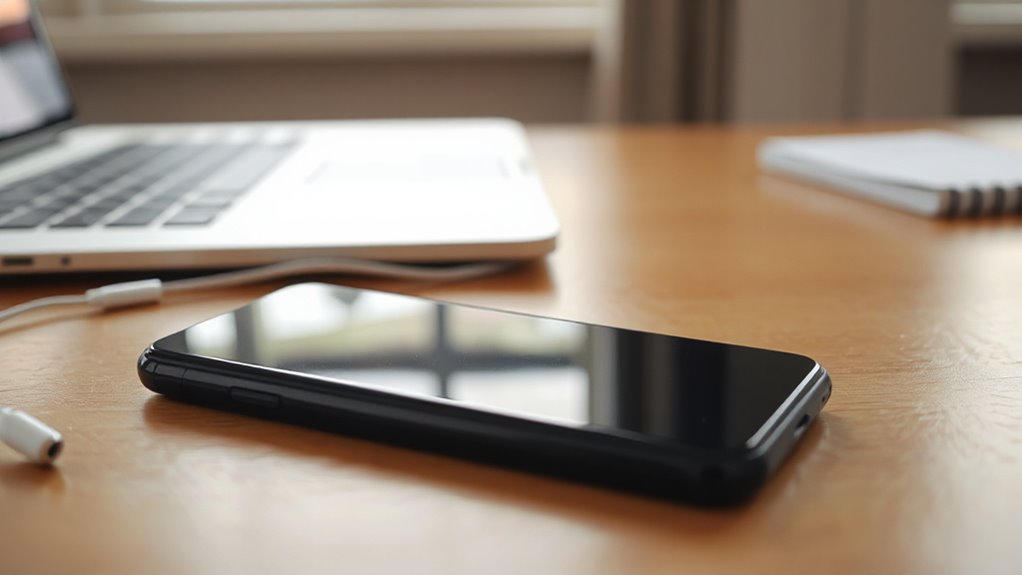
The simplest structural change a remote worker can make is silencing the phone and moving it out of arm’s reach during focused work periods.
Silence your phone and move it out of reach — the simplest structural shift for deeper focus.
Research shows that keeping a phone on ring or vibrate increases inattention and hyperactivity symptoms compared to silent mode.
Even without touching the device, notifications alone can trigger mind wandering and slow cognitive processing.
Physical distance compounds these benefits, with one study finding that reduced phone access cut usage time roughly in half.
Together, silence and distance remove two distinct distraction triggers, creating conditions where sustained attention becomes markedly easier to maintain. A single notification can slow information processing by 7 seconds, a delay that compounds significantly when workers receive around 100 notifications throughout the day.
A study of 221 university students found that participants reported significantly higher inattention and hyperactivity during weeks when their phones were kept on ring or vibrate compared to weeks when alerts were silenced, providing first experimental evidence that notification settings directly influence attention and restlessness.
Silencing notifications and keeping the phone out of reach also supports better work rhythms by encouraging single-tasking and reducing costly task-switching.
Set Home Boundaries So Domestic Life Doesn’t Break Your Focus
Silencing a phone addresses one layer of distraction, but domestic life presents an entirely different challenge for remote workers sharing space with partners, children, or roommates.
A dedicated workspace, even a consistent corner, signals that the area belongs to work. Many communities and nonprofit organizations also offer resources to help set up ergonomic or focused home offices for remote workers community programs.
A closed door communicates that interruptions should wait.
When doors are unavailable, visible cues like colored cards or headphones serve the same purpose.
Discussing working hours before the day begins reduces ambiguity about availability.
Simple protocols, such as a traffic-light system indicating focus levels, give household members clear guidance and protect concentration without making others feel dismissed or ignored.
When boundaries slip, restating them with a short message and reinforcing the physical cue rather than abandoning the system entirely supports boundary recovery without guilt.
Research shows that family interruptions during remote work function as hindrance stressors, consuming cognitive resources through forced task-switching that makes it harder to return full attention to the original work.
Schedule Specific Times to Check Your Phone and Nothing Else
Once household boundaries are established, the next layer of protection involves controlling when the phone gets attention, not just silencing it.
Batching notifications into two or three daily windows, such as late morning, midday, and late afternoon, has been linked to greater productivity, improved mood, and lower stress.
Ten-minute check blocks prevent quick message scans from expanding into prolonged distractions.
Pairing these windows with natural breaks between 60 to 90-minute focus blocks creates a reliable daily rhythm.
Tools like iPhone Scheduled Summary or Android’s built-in notification controls reinforce this structure without requiring constant willpower, making consistency substantially easier to sustain over time.
A randomized controlled trial found that delivering notifications in batches three times a day produced statistically significant reductions in stress and measurable improvements in concentration among participants.
Completely silencing the phone offers little relief, as research shows that people with no alerts reported more anxiety and unlocked their phones just as frequently as those receiving normal notifications, a pattern explained by intermittent reinforcement conditioning that sustains compulsive checking habits even when rewards are removed.
This practice can also recover lost working hours and enhance productivity across the workday.