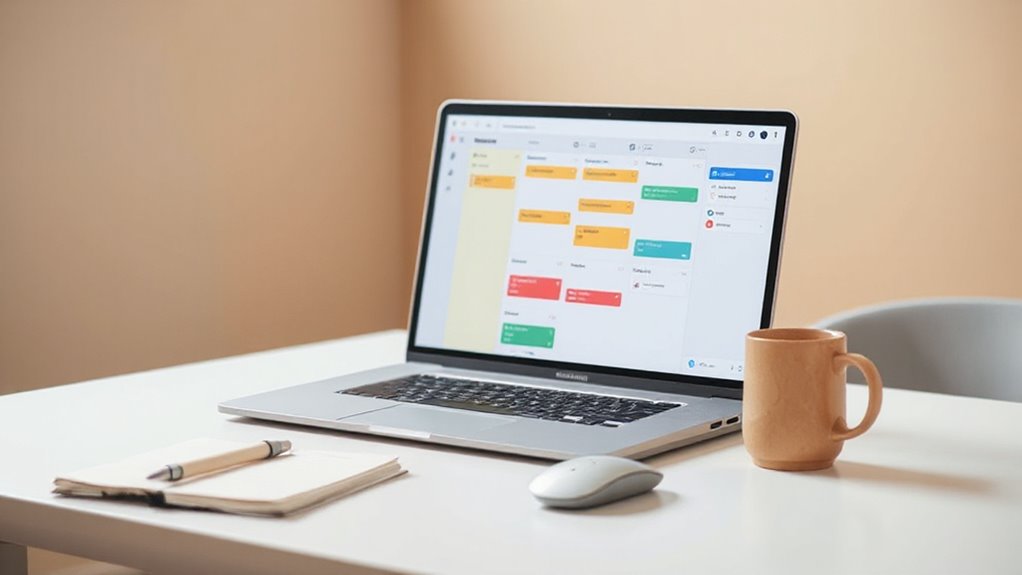
Why Remote Knowledge Workers Drown in Meetings
Remote knowledge workers face a growing paradox: the tools and structures meant to keep distributed teams connected are quietly consuming the time needed to do meaningful work. Without shared physical spaces, informal hallway coordination disappears, replaced by scheduled calls and recurring check-ins. Teams using collaborative technologies report improved performance, faster task completion, and better productivity, but those same tools also make it easier to overload calendars with low-value meetings collaboration tech.
Atlassian’s 2024 research found 78% of workers struggle to complete actual work because of meeting volume, and 51% regularly work overtime as a direct result.
Remote collaboration tools lower the friction of adding meetings, while visibility anxiety pressures workers to attend even low-value sessions. The outcome is a fragmented workday where deep, focused work rarely survives. Context switching between meetings carries a measurable cost, with research from the American Psychological Association showing up to 40% productivity reduction from the constant shifting of mental focus.
The problem is compounded by meeting quality itself, with research showing meetings are ineffective 72% of the time, leaving workers not only time-poor but frequently walking away without clear decisions or next steps.
How Meeting Overload Destroys Deep Work and Costs You Hours
When meetings consume a workday in fragments, the damage extends far beyond lost hours on a calendar. Each interruption forces a mental reset, making sustained concentration on complex tasks nearly impossible. Research from Harvard Business School confirms that more productive employees attend fewer meetings and deliberately protect focused time. Atlassian recommends 90–120 minute deep-work blocks occupying 30–40% of the week, recognizing that scattered meetings erode strategic thinking. The real cost is not just time lost but reasoning capacity diminished. Reclaiming uninterrupted blocks is not a luxury for remote knowledge workers; it is a measurable performance advantage worth protecting. Some professionals report spending nearly 23 hours weekly in meetings, more than double the time logged in the 1960s, leaving little room for the focused execution that complex work demands. Companies spend an average of $25,000 per employee annually on unnecessary meetings, making unmanaged meeting overload not only a productivity crisis but a significant financial drain on organizational resources. Implementing proven techniques like the Pomodoro Technique and timeboxing helps preserve uninterrupted focus and reduce the cumulative cost of fragmented work.
Calendar Tactics That Reclaim Deep Work Time for Remote Teams
Protecting deep work from meeting overload begins with the calendar itself, which is the most visible and controllable tool in a remote worker’s daily structure. Blocking 90 to 120 minutes during peak energy hours, typically mornings, creates reliable focus windows before fragmentation sets in. Labeling these blocks as “deep work” or “focus time” signals clear boundaries to teammates.
Enabling auto-decline features prevents last-minute requests from overriding those boundaries without requiring constant negotiation. Adding 10 to 30 minute buffers before and after meetings reduces rushed shifts. Rebuilding focus after a distraction can take up to 30 minutes, making those buffers an essential recovery investment rather than a scheduling luxury.
Clustering remaining meetings into shared windows preserves longer, uninterrupted stretches that concentrated thinking genuinely requires. AI scheduling tools like Clockwise, Motion, and Reclaim.ai can automatically shift meetings to protect those uninterrupted sessions without manual effort. Organizations that adopt AI for scheduling often see time saved and faster routine workflows, freeing more hours for focused work.
Team-Level Rules That Cut Meeting Overload at the Source
Calendar tactics create the structure for focused work, but individual scheduling habits can only accomplish so much when the team itself generates a steady stream of unnecessary meetings.
Lasting relief requires shared rules that govern how meetings are called, attended, and ended.
Teams benefit from requiring a clear purpose on every invite, keeping attendance lists small, and defaulting to asynchronous updates for routine status information.
Recurring meetings should face periodic audits and expire without renewal. Meetings that continue running after a project ends or gradually expand beyond their original scope represent the kind of recurring meeting accumulation that compounds calendar waste across the entire team over time.
Agendas, preparation materials, and defined outcomes shift meetings from vague conversations into efficient decisions, protecting everyone’s time at the source rather than after the damage is done.
Research shows that employees operating under meeting overload conditions are left with only 43% of their time available for productive work, making shared team agreements not a courtesy but a structural necessity. Teams should also assign roles during meetings to keep discussions efficient and accountable.
How Remote Teams Stop Meeting Culture From Creeping Back
Shared rules and calendar structure give remote teams a strong foundation, but meeting culture has a way of rebuilding itself quietly over time.
Managers play the central role here, since their habits signal whether minimal-meeting behavior is genuinely valued or merely tolerated.
Managers set the tone — their habits reveal whether meeting minimalism is truly valued or just lip service.
Replacing large group calls with smaller, targeted check-ins preserves working relationships without bloating calendars. Using Kanban boards and clear task assignments can further reduce the need for recurring status meetings by making progress visible.
Separating collaboration bursts from quiet work periods reduces constant meeting pressure.
When cross-team coordination is the underlying problem, assigning a dedicated liaison often eliminates repeated group meetings entirely.
Sustained discipline, not just initial reform, determines whether focus time remains protected. Quick informal exchanges over messaging platforms, often called huddles, can replace calendar-based meetings and resolve questions in minutes rather than requiring scheduled time from the entire team.
Status updates, one of the most common meeting triggers, can be shared asynchronously by all participants, removing the need for a scheduled call entirely.
Related Posts