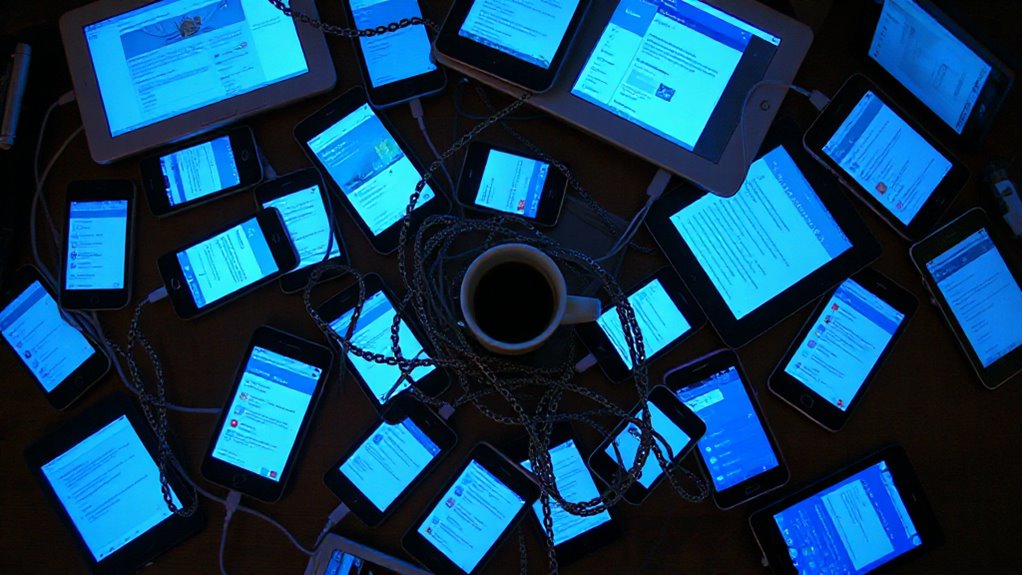
Knowledge workers are hemorrhaging precious time to the very tools designed to boost their efficiency. Research reveals that the average knowledge worker spends only 30 hours of a standard 40-hour week on productive work, losing roughly 11 hours to non-productive activities. This 28% time drain represents a staggering $31,000 per worker in economic losses in the United States alone, with the primary culprits being collaboration platforms and fragmented information systems.
Knowledge workers lose 11 hours weekly to productivity tools meant to help them, costing $31,000 per employee annually.
Communication tools consume 3.6 hours weekly just managing internal workplace messages, with workers losing 157 hours annually to unproductive chat exchanges. Despite their collaboration benefits, chat applications have become top workplace disruptors, contributing to the reality that 57% of the workday is spent communicating through meetings, email, and messaging platforms. Half of the time workers spend on chat messages proves wasteful, while constant notifications interrupt focus every three minutes, requiring up to three hours daily for mental refocusing. The pressure to respond instantly exacerbates the problem, with 60% of workers feeling pressured to respond quickly to incoming messages. AI-powered automated reminders and scheduling tools can reduce coordination time and interruption frequency by streamlining meeting setup and follow-ups, improving efficiency for many teams with automated scheduling.
The information search problem compounds these challenges. Workers spend 2.8 hours weekly hunting for needed information across an average of 367 applications and systems. Some professionals waste up to eight hours weekly searching inefficiently without expert guidance, as organizational silos spread critical knowledge across too many disconnected tools.
This fragmentation forces workers to spend 32 days yearly merely toggling between digital platforms.
Meetings add another layer of inefficiency, consuming 2.2 hours weekly in unnecessary or unproductive sessions. These gathering drain 79 hours annually per worker, with cross-functional collaboration hindered by silos in 51% of cases. Meanwhile, five hours weekly vanish waiting for coworkers who possess unique knowledge, and over four hours are lost to duplicating work that already exists elsewhere. These productivity drains translate into lower job satisfaction for nearly 60 percent of employees when left unaddressed.
The path forward requires strategic intervention. Training and mentoring programs reduce time spent recreating existing information, while AI-powered automation has boosted productivity for 79% of adopters. Enterprise search capabilities and exhaustive documentation systems cut operational risks, and self-service information access through AI documentation assistants offers promising solutions.
Organizations must recognize that accumulating productivity tools without integration strategy transforms efficiency enablers into productivity killers.