







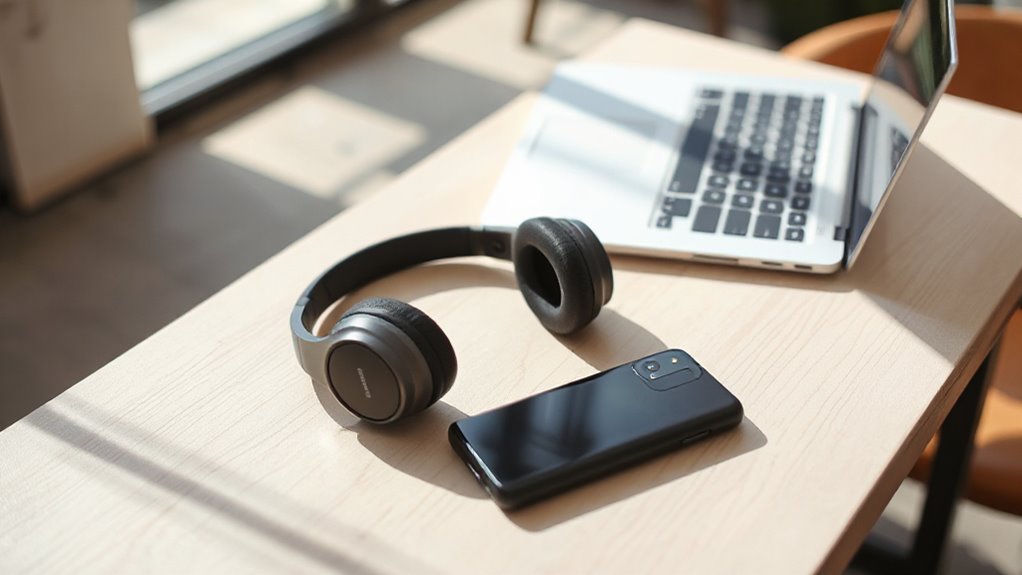
In an era defined by distributed workforces and mobile productivity, headphones have evolved from simple audio accessories into essential tools for building effective portable offices. Professionals across industries now rely on these devices to create focused work environments wherever their schedules take them, from coffee shops and airport lounges to home offices and coworking spaces.
Headphones have transformed into indispensable infrastructure for modern professionals building productive workspaces across airports, cafes, and beyond traditional offices.
The data reveals substantial adoption among workplace users who depend on headphones for managing audio from mobile devices throughout their day. In-ear models have gained particular traction among heavy users in office settings, valued for their lightweight design and secure fit that effectively negates external noise. This portability factor has made them indispensable for professionals who shift between locations, with the global in-ear headphones segment projected to reach USD 30 billion by 2026 at a CAGR of 10.97%. Many professionals also report meaningful productivity gains when combining headphones with AI tools to streamline tasks and focus on higher-value work productivity improvements.
Millennials, who comprise 37% of Canada’s workforce and dominate North America‘s professional landscape, have driven significant demand for advanced headphone features. These users prioritize wireless solutions that eliminate cable constraints, contributing to the true wireless headphones market’s projected growth to USD 18 billion by 2026. The removal of headphone jacks from smartphones has accelerated this shift, with the Bluetooth headphones market expected to increase by USD 22.80 billion from 2025 to 2030.
Modern headphone features directly address portable office requirements. Premium models like Apple AirPods Pro offer 30 hours of total listening time with their charging case, while Bose QuietComfort Ultra provides 30 hours of active noise cancellation for uninterrupted focus. Ambient noise control and sound transparency modes allow users to remain aware of their surroundings while maintaining productivity, essential capabilities for public workspace navigation. The pandemic further accelerated ANC demand as professionals sought to control environmental distractions while working indoors from varied locations. Among professionals utilizing headphones for work, teleworking usage accounts for 14% of primary headphone activities.
The broader headphones market reflects this professional adoption, with projections estimating growth from USD 41.75 billion in 2024 to USD 103.55 billion by 2033. North America leads this expansion, fueled by demand for sophisticated audio solutions that support flexible work arrangements. As professionals increasingly value location independence, headphones have become foundational infrastructure for the portable office concept, enabling productivity without geographic constraints.
Related Posts