






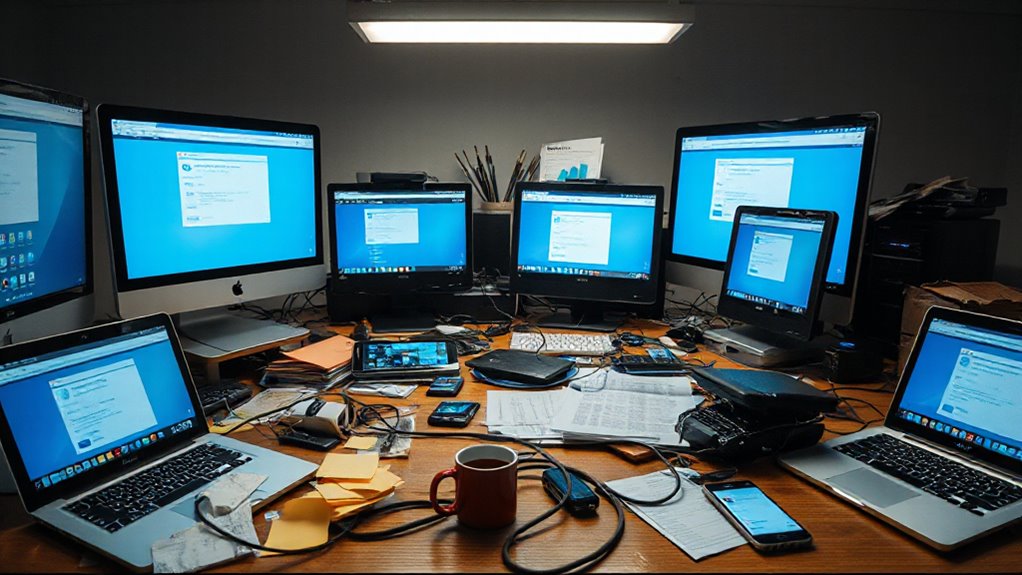
Why Adding More Software Tools Triggers Diminishing Returns
At a certain point, adding more software tools stops solving problems and starts creating new ones.
More tools don’t always mean more solutions — sometimes they simply mean more problems.
Knowledge workers already navigate roughly 30 applications daily, generating nearly 3,000 context switches before the workday ends.
Each new platform introduces another login, interface, and workflow, compounding complexity rather than reducing it.
Research confirms that 96% of workers in high-cognitive-load environments spend as much effort deciding how to complete work as actually doing it.
When tools multiply faster than teams can absorb them, friction increases and output stalls.
Employees spend an average of at least two hours a day searching for documents, information, or people, meaning 25% of a workweek is lost before meaningful work even begins.
BCG research found that moving from three to four simultaneously used AI tools resulted in self-reported productivity decline, revealing that more tools do not equate to better outcomes.
Growth comes not from accumulating software, but from deploying fewer, better-integrated tools with genuine purpose.
Many organizations therefore consolidate platforms to centralize work and improve oversight with dashboards and workflows, reducing scattered emails and files.
The Hidden Productivity Tax of Redundant Workplace Tools
The problem with tool accumulation goes beyond complexity—it carries a measurable financial and operational cost that most organizations never fully account for.
Research shows that 46% of SaaS licenses go unused across the average organization, meaning nearly half of software spending delivers nothing. This inefficiency often hides operational costs that automation could help reduce.
Redundant tools also fragment workflows, splitting conversations and files across platforms and forcing employees to manually transfer information between systems.
Workers lose up to 1.5 days weekly moving through disconnected tools and reconstructing scattered data.
Security solutions like Cloudflare can block site access entirely when triggered by routine employee actions, adding yet another layer of friction to already fragmented digital work environments.
Shadow IT compounds these costs further, with the median company’s unmanaged software spend representing 35–40% of total SaaS budget—money spent on tools that IT cannot monitor, secure, or consolidate.
Recognizing these hidden costs is the first step toward building leaner, more intentional technology stacks that actually support productivity rather than quietly undermine it.
How Constant App-Switching Drains Focus and Time
Constantly switching between applications may feel like multitasking, but research suggests it functions more like a productivity leak that quietly compounds throughout the workday.
Knowledge workers switch between roughly 10 apps 25 times daily, losing approximately 36 minutes to hand-offs alone.
Each hand-off triggers attention residue, leaving mental energy anchored to the previous task.
Recovery after a single app change can consume nearly 9.5 minutes of productive momentum.
These costs accumulate into an estimated 40% productivity loss.
Recognizing this pattern is the first step toward building workflows that protect focus rather than continuously fragment it. Context switching increases the risk of errors and creates mental fatigue that further erodes the quality of work produced throughout the day.
Research by Weinberg found that each additional task added to a person’s workload can consume anywhere from 20% to 80% of available productivity, meaning even a modest increase in concurrent responsibilities carries a steep cognitive price.
Creating distraction-free workspaces and limiting notifications helps reduce the frequency of interruptions and preserves attention.
The Hidden Cost of Communication Overload
Even when individual tools work as intended, the sheer volume of communication channels competing for attention creates a burden that extends well beyond simple distraction.
Communication overload now costs organizations an estimated $21 billion per week, while workers collectively spend 252 million hours daily on email, messaging, video, and calls.
Nearly half of employees report missed deadlines linked to miscommunication, and 45% describe communicating as the most mentally taxing part of their job.
Recognizing these costs is the first step toward addressing them. Research shows that communication overload triggers fatigue and attitude shifts that simultaneously drive workers toward both continuing and abandoning collaboration tools. Centralized platforms that reduce app-switching can reclaim time and focus by consolidating communication and project workflows into a single digital platform.
At its most severe, unmanaged communication overload can contribute to burnout, attrition, and lost productivity across an organization.
Organizations that audit communication habits and streamline channels can meaningfully recover both time and focus.
How Tool Fatigue Leads to Burnout, Stress, and Employee Turnover
When digital tools multiply faster than workers can adapt, the result is more than inconvenience—it becomes a measurable threat to employee health and organizational stability.
Constant switching between platforms drains cognitive resources, contributing to techno-overload, a recognized driver of exhaustion and burnout. This cumulative pressure can be measured with stress tests that evaluate how employees perform under controlled challenging conditions.
Employees under sustained technology pressure report heightened stress, eroded morale, and blurred work-life boundaries.
Over time, these conditions reduce organizational commitment and increase turnover intentions. Research confirms that job insecurity mediates the relationship between techno-overload and turnover intention, meaning technology pressure does not simply frustrate workers—it makes them fear for their positions and ultimately seek to leave.
Organizations that ignore these signals absorb real costs, including absenteeism, lower performance, and lost talent. Stable Wi‑Fi connectivity was associated with 59% higher productivity than interrupted connectivity, underscoring how infrastructure-level decisions directly shape performance outcomes.
Streamlining tool environments is not optional—it is a foundational step toward protecting both people and productivity.