






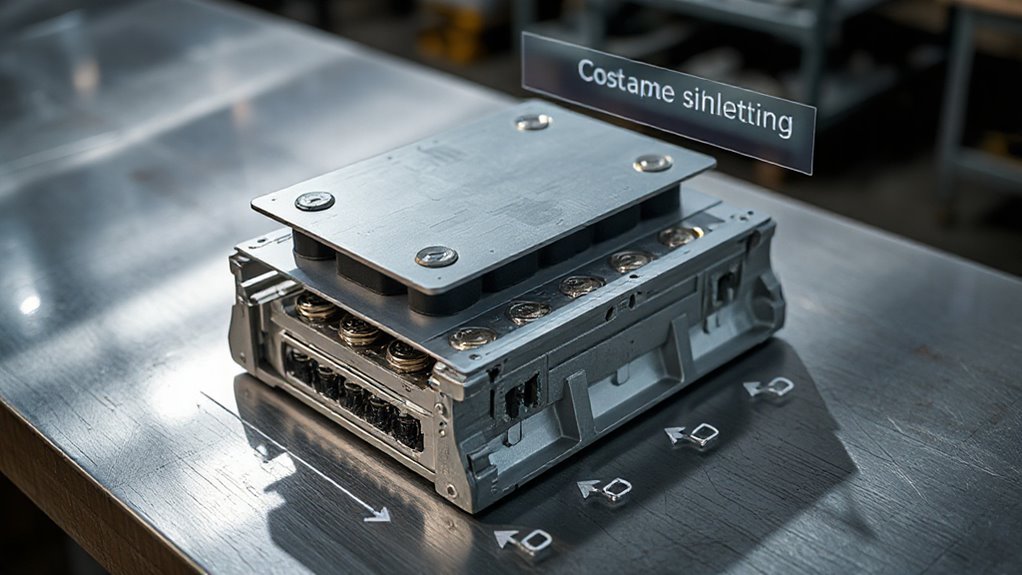
Why Most Battery Cost Models Get It Wrong
Battery cost modeling is a field where small assumptions can produce dramatically different conclusions, and understanding why requires looking closely at how models are built.
Many published estimates report battery pack cost alone, excluding integration, thermal management, and warranty expenses.
Production volume assumptions compound the problem, since costs modeled at 500,000 units annually look very different from 100,000-unit scenarios.
Linear extrapolations further distort results by ignoring manufacturing complexity, yield losses, and equipment step changes.
Hidden cost buckets, including factory depreciation, overhead, and labor, frequently disappear from simplified analyses.
Recognizing these gaps is the essential first step toward building more reliable, actionable cost strategies. Most cost reduction across scenarios is attributed to battery pack costs, with BOS, installation, and other cost contributions expected to contribute only minimally to overall savings.
Many existing models, including widely referenced tools like BatPac, fail to account for energy costs and scrap rates, limiting their accuracy for real-world manufacturing decisions.
Empirical benchmarking using revenue per employee and other productivity measures can reveal where model assumptions diverge from operational reality.
Start With Chemistry: The Largest Battery Cost Lever
Of all the decisions that shape a battery pack’s final cost, chemistry selection carries the most weight. Cathode active material alone accounts for 40–50% of cell production costs in NMC batteries and 25–30% in LFP batteries. Small operational improvements and automation can further reduce downstream assembly and processing expenses, especially when handling document processing tasks.
Since raw materials represent over 65% of total pack cost, chemistry choice determines which commodity risks dominate the entire cost structure.
Since raw materials dominate pack costs, chemistry selection ultimately determines which commodity risks define your entire cost structure.
LFP packs cost approximately €64/kWh compared to €82/kWh for NMC, translating into pack-cost advantages of €2,000–€4,000 for midsize vehicles.
First principles thinking begins here: identify which metals the application truly requires, then select the least expensive chemistry that meets those specific performance demands. Unlike NMC, LFP contains neither nickel nor cobalt, relying instead on iron and phosphates that are among the most abundant materials in Earth’s crust.
Battery prices have fallen nearly 90% over the past decade, with 2025 pack costs averaging about $99 per kilowatt-hour, marking the second consecutive year below the $100 threshold.
Right-Size the Pack Before You Design the Cell
Chemistry selection sets the cost ceiling, but pack sizing determines how much of that ceiling the design actually reaches.
Starting from peak current, average current, and duty cycle gives engineers a grounded baseline, while arbitrary kWh targets invite oversizing and unnecessary cost.
Usable capacity is typically derated to 80–85% of nameplate for cycle-life protection, with additional margin reserved for end-of-life performance. Regular review and adjustment of targets helps keep designs aligned with actual mission needs and measurable outcomes.
Parallel cell count should satisfy current requirements before energy capacity is expanded.
Every unjustified cell added carries direct material cost plus associated hardware.
Sizing from actual mission profile, rather than worst-case peak conditions, is where meaningful cost reduction begins. Running cells near datasheet limits drives heat, voltage sag under load, and early cycle-life failure, which compounds material waste with premature replacement cost.
Battery energy and power must be specified across the full vehicle lifecycle, accounting for the fact that cell aging reduces available capability from beginning to end of life, which means any pack sized without that buffer will fall short of performance targets before the vehicle reaches retirement.
Reduce Separator, Copper, and Packaging Mass Per kWh
Once pack size is locked in, the next opportunity lies in trimming the mass of components that store no energy but still show up in every kilogram weighed on the scale.
Separator thickness can drop from 20 µm toward functional minimums without sacrificing safety. Visual mapping of the process helps identify which steps to standardize and optimize for mass reduction workflow transparency.
Copper foil has already thinned from 20 µm to roughly 6 µm in modern designs, meaningfully cutting the roughly 16–50 kg copper burden found in pack studies.
Packaging consolidation removes structural redundancy. Benchmarking data indicates that pack mass runs 1.6× the total cell mass, revealing how much overhead packaging and structure currently add beyond the cells themselves.
Each lever compounds: thinner foils, leaner enclosures, and right-sized separators collectively shrink inactive mass per kWh without touching active chemistry.
Build the Cost Reduction Sequence From the Bottom Up
The most effective cost reduction strategies follow a deliberate sequence, starting with the highest-impact levers before moving to finer optimizations. Engineers who apply first principles thinking typically progress through four ordered priorities:
- Select lower-cost cathode chemistries, such as LFP over high-cobalt formulations.
- Improve active material specific capacity to reduce total material mass per kWh.
- Increase manufacturing yield to eliminate embedded material waste.
- Simplify pack architecture through cell-to-pack designs that remove modules.
Each step builds on the previous one. Addressing cathode chemistry first delivers the largest savings, making downstream optimizations progressively more effective and financially meaningful. Transparent process-based cost modeling enables engineers to quantify the impact of each lever before committing to a design direction. Organizations with standardized practices can also realize substantial savings by avoiding inefficiencies and waste through financial controls.