







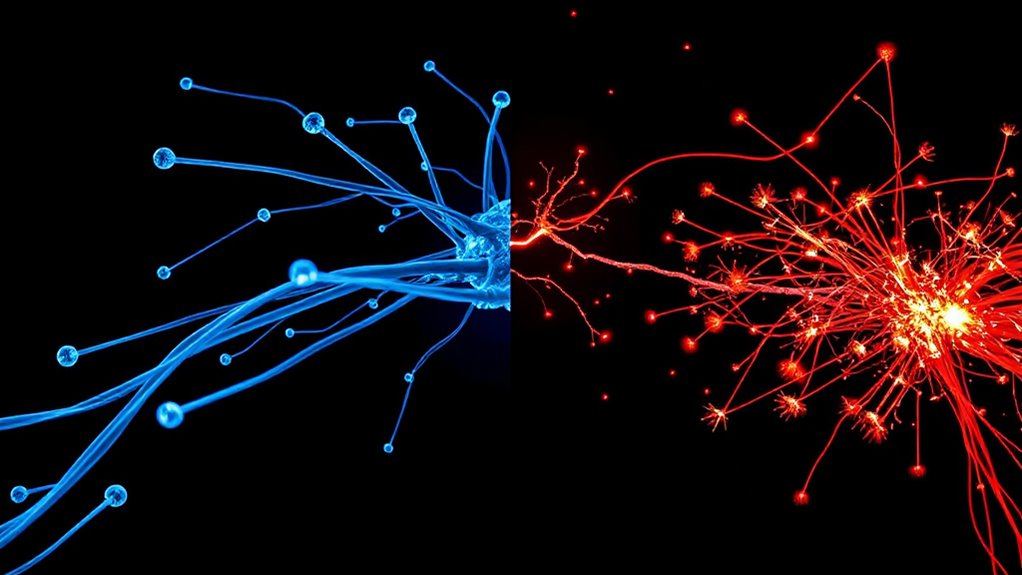
Understanding how the brain responds to urgency reveals a fundamental tension in human cognition: the competition between careful, goal-directed thinking and rapid, stimulus-driven action. Research demonstrates that when time pressure intensifies, the brain’s prefrontal mechanisms responsible for maintaining deliberate, intentional behavior become temporarily overridden, allowing external stimuli to dominate responses instead. Neural filtering and inhibitory circuits help determine which stimuli reach higher processing, and these mechanisms can be compromised under high urgency, reducing the brain’s ability to suppress irrelevant inputs and maintain focus (inhibitory circuits).
Under time pressure, the brain’s deliberate control systems are overridden, forcing rapid reactions to external stimuli instead of strategic thinking.
This neurological shift explains why people struggle with timing under pressure. The basal ganglia, particularly the caudate nucleus, generates urgency signals that operate independently of sensory information. These signals create a temporary window during which stimulus-driven reactions take precedence over goal-directed intentions. In effect, urgency disables the executive function capabilities that normally help maintain focus on objectives, forcing individuals to respond reactively rather than strategically.
Physiological markers confirm this neurological hijacking. Pupil dilation increases correlate directly with urgency levels, while saccade peak velocity rises in response to time pressure. These changes indicate a momentary state of heightened neuronal arousal, likely mediated through norepinephrine modulation. The brain in effect shifts into a different operational mode when urgency strikes.
The decision-making process itself transforms under urgency. Neural activity in regions like the fusiform gyrus reflects how urgency signals modulate evidence accumulation rates. When task information becomes ambiguous, urgency gating actually slows decisions, creating a paradoxical effect where pressure to respond quickly makes efficient decision-making more difficult. This mechanism extends beyond simple eye movements to manual tasks and general behavioral responses across multiple action domains. Traditional models of decision-making assume gradual evidence accumulation toward a fixed threshold, but these frameworks struggle to account for the rapid choices people make under incomplete information.
Importantly, this response represents a fundamental feature of human neurology rather than a personal failing. The brain mechanisms controlling urgency involve cognitive control regions that govern many aspects of behavior. When these systems become temporarily compromised by time pressure, even individuals with strong executive function capabilities experience reduced conflict resolution abilities. Goal-conflicting stimulus features naturally dominate responses during these periods, regardless of intent or skill level. Studies using both spatial tasks and nonspatial tasks like the flanker task demonstrate that this phenomenon appears consistently across different types of cognitive challenges. Recognizing this biological reality allows for more realistic expectations and better strategies for managing high-pressure situations effectively.
Related Posts