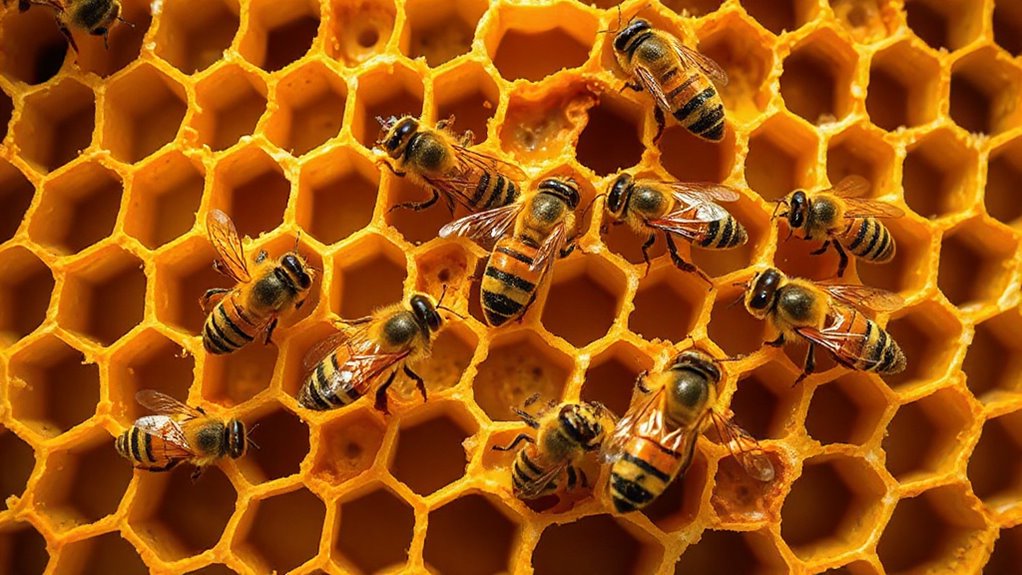
Maximizing productivity like bees requires systematic resource allocation, clear role definition, and collaborative efficiency. Organizations achieve 45% productivity gains by improving existing processes rather than expanding operations. Effective teams address multiple stressors simultaneously through holistic management approaches, while maintaining adaptability for seasonal variations and changing conditions. Strategic process enhancement, proper planning, and division of labor create sustainable productivity improvements. These natural principles offer powerful frameworks for transforming workplace efficiency and organizational performance.
How can individuals and organizations achieve the remarkable productivity levels demonstrated by honey bee colonies? The answer lies in understanding the sophisticated management practices and collaborative behaviors that enable these remarkable insects to maximize their output through systematic approaches and efficient resource allocation.
Honey bee colonies demonstrate that foundational preparation directly impacts long-term success. Just as nuclei preparation proves essential for colony health, individuals must establish strong foundations in their work environments. Proper planning, adequate resource allocation, and timely updates to systems and processes mirror how beekeepers maintain ideal brood chamber conditions and replace queens when necessary to sustain vigor and productivity.
Global data reveals that honey production per colony has increased by 45% in recent decades, primarily through improved management practices rather than simply expanding operations. This efficiency gain demonstrates that working smarter, not harder, produces superior results. Organizations can apply this principle by focusing on enhancing existing processes rather than continuously adding new projects or team members without strategic purpose.
The devastating impact of colony losses, which cost the industry over $600 million annually, underscores the importance of addressing multiple stressors simultaneously. Similarly, productivity challenges in human environments rarely stem from single causes. Successful individuals and teams adopt holistic approaches that address various factors affecting performance, from workflow design to environmental conditions.
Resource gathering behaviors offer particularly valuable insights for productivity enhancement. Average colonies collect approximately 40 pounds of pollen and 265 pounds of nectar annually through efficient foraging strategies that emphasize cooperation and division of labor. This translates to clear role definition, effective collaboration, and systematic approaches to task completion in human contexts. The landscape composition affects bee productivity significantly, as intensive cultivation of specialized crops creates both opportunities and challenges for colony performance.
Seasonal variations in colony health remind us that productivity naturally fluctuates, requiring adaptive strategies throughout different periods. Rather than expecting consistent output regardless of circumstances, successful operations build flexibility into their systems while maintaining core productivity principles. The shift from Europe and North America’s historical dominance to Asia’s emergence as a major honey producer demonstrates how geographic centers of excellence can change through improved practices and strategic focus.
The key lesson from bee productivity extends beyond individual effort to encompass systematic management, collaborative efficiency, and adaptive resilience. By implementing structured approaches that prioritize preparation, cooperation, and continuous improvement, individuals and organizations can achieve sustained productivity gains that mirror nature’s most efficient workers.
Frequently Asked Questions
What Specific Time Management Apps Best Replicate Bee Colony Efficiency Patterns?
Task management apps that incorporate rhythmic scheduling, automated reminders, and collaborative workflows most effectively replicate bee colony efficiency patterns. Applications featuring time-blocking capabilities, priority-based task organization, and seamless team coordination mirror how bees allocate resources and communicate duties.
The most successful platforms integrate offline functionality, visual progress tracking, and adaptive scheduling algorithms that adjust to changing priorities, mimicking colonies’ responsive organizational structures.
How Can Remote Teams Implement Bee-Inspired Communication Without Constant Video Calls?
Remote teams can adopt bee-inspired communication through targeted location-specific updates rather than broad announcements, mimicking waggle dance precision. Teams should balance personal expertise with periodic shared insights, avoiding communication overload.
Encouraging diverse communication styles—written updates, voice messages, or visual demonstrations—enhances message clarity. Asynchronous recorded briefings and mentorship repositories enable skill development without constant live interaction, reducing meeting fatigue while maintaining effective collaboration and knowledge transfer.
Are There Personality Types That Naturally Resist Bee-Like Productivity Methods?
Certain personality types naturally resist highly structured productivity methods. Type B personalities prefer leisure and work-life balance over constant efficiency demands.
Individuals high in neuroticism struggle with stress-intensive approaches, while those scoring high in openness may find repetitive systems boring.
Agreeable personalities often resist competitive, individualistic methods, favoring collaborative environments.
However, personality traits can be modified through training and environmental factors over time.
What’s the Ideal Break Schedule When Following Bee Productivity Principles?
The ideal break schedule follows natural bee rhythms with short, frequent pauses every 25-30 minutes during intense work periods. These breaks should last 5-10 minutes and include physical movement or workspace organization.
Longer 15-20 minute breaks occur between major task shifts, similar to how bees rest when switching from foraging to hive maintenance. Schedule breaks proactively in calendars to prevent burnout and maintain sustained performance throughout productive daylight hours.
How Do You Measure Success Using Bee Efficiency Metrics in Office Environments?
Organizations measure success through bee-inspired metrics by tracking task completion rates, time-to-full productivity for new employees, and work time utilization patterns. They monitor energy consumption, waste diversion rates, and operational cost savings to reflect resource efficiency.
Employee attendance, revenue per worker, and quarterly productivity reports provide extensive performance data. Activity monitoring and burnout risk assessments ensure sustainable workflows, mirroring the balanced workload distribution found in thriving bee colonies.