Why Open Office Noise Increases Stress and Kills Productivity
The relentless hum of conversations, ringing phones, and keyboard clatter in open-plan offices triggers measurable physiological changes that undermine both well-being and work quality.
Research reveals that just eight minutes of exposure increases sweat response by 34%, while heart rate and skin conductivity spike as reliable stress markers.
Negative mood heightens by 25% under these conditions, confirmed through facial recognition software and self-reported scales.
Most dramatically, cognitive performance plummets by up to two-thirds when colleagues’ conversations intrude. With 70% of workers experiencing concentration difficulties, the productivity cost becomes undeniable, turning workspaces into stress incubators rather than innovation hubs.
Chronic exposure can contribute to long-term cardiovascular strain by raising cortisol and activating the sympathetic nervous system, which increases blood pressure and damages blood vessels over time.
How Speech Distraction Destroys Your Working Memory
Working memory—the mental workspace where information gets temporarily held and manipulated during complex tasks—faces a particularly insidious threat from speech distraction in open offices.
Research demonstrates that even non-informational speech spectrum noise disrupts verbal short-term memory performance, reducing accuracy in attention-switching tasks.
The damage intensifies under high cognitive load: when mental demands increase, the brain’s ability to suppress irrelevant auditory input diminishes markedly.
This creates a vicious cycle where difficult tasks requiring maximum working memory capacity simultaneously make workers more vulnerable to surrounding conversations.
Speech distraction fundamentally impairs the proper allocation of cognitive resources, compromising both comprehension and task execution.
The Real Reasons Open Offices Are So Loud
Behind every complaint about open-office cacophony lies a predictable set of architectural and behavioral culprits that transform collaborative workspaces into acoustic battlegrounds.
- Conversation overflow: Over 80% of tertiary sector employees cite colleague discussions as their primary distraction, with voices exceeding 55 decibels triggering measurable stress responses
- Phone disruptions: Ringing tones consistently rank as the most annoying workplace sound, disturbing 95% of open-office occupants
- Unpredictable interruptions: Random noise from printers, phones, and spontaneous conversations creates cognitive whiplash that prevents sustained concentration
- Inadequate sound barriers: Poor acoustic design amplifies rather than dampens everyday workplace activities
Understanding these factors empowers organizations to implement targeted solutions. Companies with strong communication skills see 25% higher productivity, which makes addressing acoustic issues a smart investment.
Acoustic Design Fixes That Reduce Noise Without Walls
Rather than resign themselves to the acoustic chaos of open-plan environments, forward-thinking organizations can deploy strategic design interventions that preserve collaboration while restoring productive quiet.
Ceiling-mounted acoustic rafts and baffles absorb reflections from hard surfaces—one installation of ten panels reduced reverberation time from 1.74 seconds to 0.61 seconds in a 160-cubic-meter space.
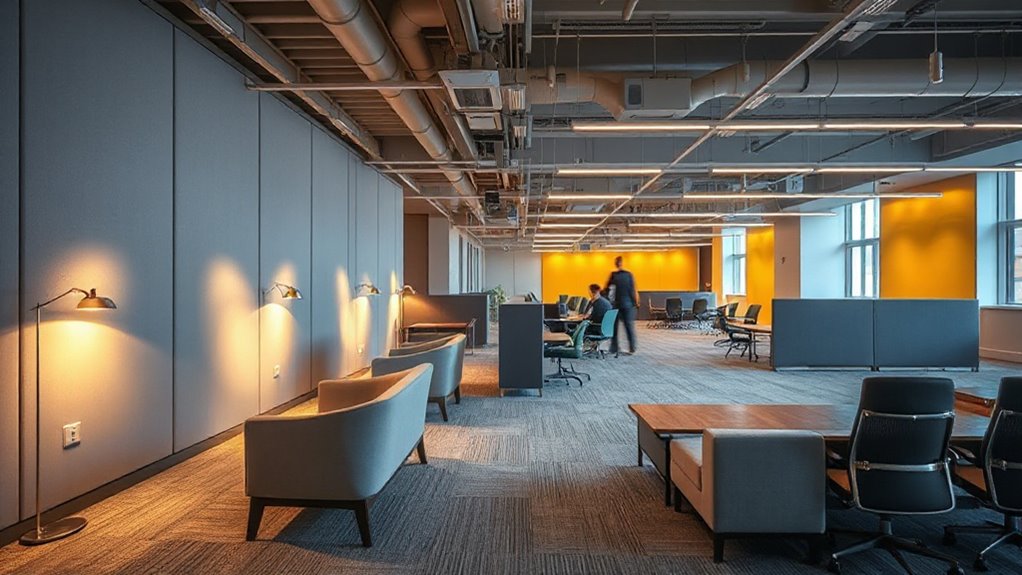
Wall-mounted PET felt panels near workstations control echo, while upholstered furniture with high backs provides localized sound dampening.
Freestanding acoustic screens between desks limit noise propagation without permanent construction.
Together, these layered solutions address multiple noise sources thoroughly, creating focus zones that support concentration while maintaining the collaborative spirit.
Leaders should also prioritize creating psychological safety so employees feel comfortable using and adapting these quiet zones to their work needs.
Quiet Zones, Sound Masking, and Office Layouts That Actually Work
Beyond acoustic panels and absorption materials, the spatial organization of an office determines whether employees can actually find the quiet they need when concentration matters most. Purposeful zoning separates collaboration and focus areas using furniture, partitions, and clear signage like “Focus Zone” markers. These designated quiet zones maintain 35-40 dB background noise levels, delivering an 18% increase in focus time while reducing stress.
Effective quiet zone strategies include:
- Library zones with shelves, plants, and calming elements for reading or laptop work
- Phone booths offering 30-35 dB insulation for confidential calls and video conferencing
- Quiet corners transforming underutilized nooks with acoustic panels and task lighting
- Mobile partitions enabling dynamic space adaptation without permanent structural changes
Research shows that combining zoning with flexible work policies — such as hybrid schedules that include 2–3 days remote — further boosts productivity and reduces turnover.