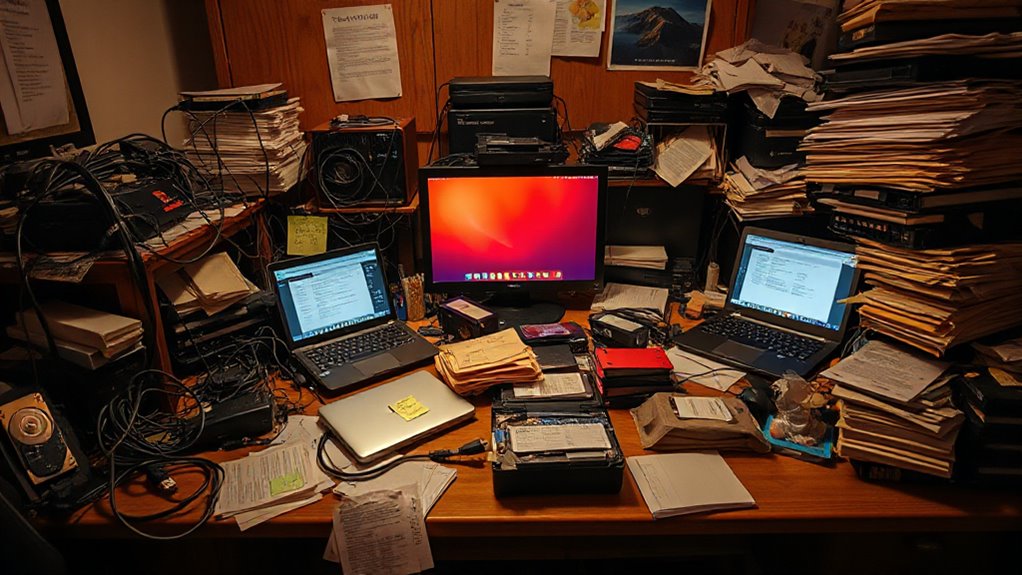
Signs Your College Note-Saving Has Crossed Into Hoarding
There is a fine line between diligent note-keeping and compulsive digital accumulation, and recognizing which side one stands on can greatly affect academic success.
Warning signs include storing over 500 GB of unorganized files, maintaining thousands of PDFs without subcategories, and retaining corrupted or incomplete documents. Regular maintenance like deleting duplicates and repairing corrupted files can prevent wasted space and lost information, especially when using file-repair tools.
Thousands of unsorted PDFs, corrupted files, and hundreds of gigabytes of chaos are not preparation — they are warning signs.
When deleting old lecture files triggers significant anxiety, the behavior likely exceeds practical studying.
Physical consequences follow digital disorder, as printed note piles consume workspace and disorganization delays assignment completion by days.
If locating active study tools feels impossible amid folder overload, the accumulation has shifted from preparation into hoarding. Unlike hoarding, healthy organization involves proudly displaying collections and keeping them well structured for easy retrieval.
Those who suspect their accumulation habits reflect a deeper issue should see a GP, as hoarding disorder is a recognized condition that may require professional diagnosis and treatment.
Why College Students Keep Every Note They’ve Ever Taken
Understanding why students accumulate notes so aggressively requires looking beyond the obvious signs of disorder. Several genuine motivations drive this behavior.
Students fear forgetting complex concepts after graduation, particularly when professional certifications demand foundational knowledge. Engineers, medical professionals, and legal experts regularly revisit archived materials for career-related problem solving.
Peer collaboration also encourages retention, since colleagues frequently request shared notes for difficult upcoming courses.
Additionally, cloud storage eliminates physical constraints, making accumulation effortless. Cloud services like iCloud Drive often sync notes across devices, reducing the friction of keeping everything.
Emotional attachment to hard work further reinforces the habit.
Recognizing these legitimate motivations helps students distinguish purposeful archiving from anxiety-driven hoarding, enabling smarter, more intentional decisions about what truly deserves preservation. Notes taken during college courses can also serve as preparation tools for advance courses and independent study, giving students a head start when encountering related material in future academic or professional settings. Keeping all notes for a single course together in one organized location makes it significantly easier to retrieve and review them when that material becomes relevant again.
How to Organize College Notes Without the Clutter
Once a student commits to organizing their notes intentionally, the process becomes far less overwhelming than it initially appears.
The moment a student chooses intentional organization, the overwhelming complexity quietly transforms into manageable clarity.
Establishing a top-level folder named by semester, such as “Fall2026_Notes,” creates an immediate structural foundation.
Within each course, subfolders like “Lectures,” “Assignments,” and “Readings” separate content cleanly.
Standardized file naming, incorporating date, course code, and topic, eliminates confusion during review.
Maintaining a daily-processed “Inbox” subfolder prevents accumulation before it starts.
Applying the one-touch rule, meaning files are placed correctly upon creation rather than sorted later, keeps the system functional.
Consistent habits, not complex systems, determine long-term organizational success. For students who prefer physical materials alongside digital ones, inserting loose-leaf notes into page protectors at the end of each class keeps papers clean, dry, and tear free without disrupting the overall workflow.
Students using cloud-based tools like OneNote and Google Drive gain the added advantage of accessing their organized notes from any device, significantly reducing the risk of losing critical work. Implementing version control practices can help track changes and prevent accidental overwrites.