







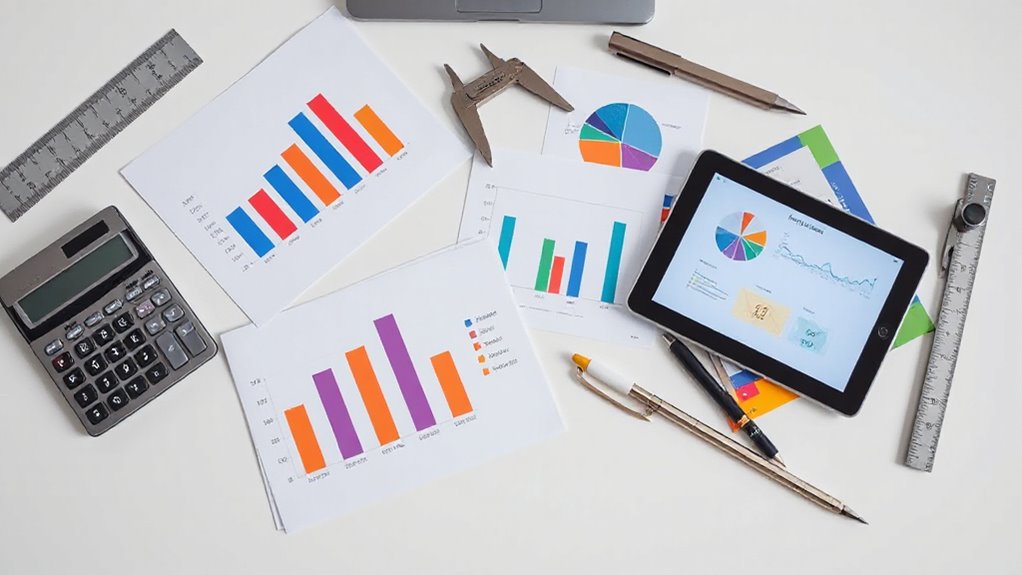
Measuring productivity effectively involves calculating the ratio of total output to total input across key organizational resources. Organizations can track labor productivity through output per employee or hour worked, while total factor productivity provides a thorough view by incorporating labor, capital, and materials. Essential data collection includes physical units produced, hours worked, and capital investments, supported by project management platforms and productivity software for accurate tracking. These systematic approaches enable businesses to identify inefficiencies, benchmark against industry standards, and develop data-driven improvement strategies that enhance operational effectiveness and drive sustainable growth.

How can organizations accurately assess their performance and identify opportunities for improvement? The answer lies in understanding and implementing effective productivity measurement systems that provide clear insights into operational efficiency and growth potential.
Productivity fundamentally represents the ratio of output produced to inputs used in production. This core concept forms the foundation for various measurement approaches, each designed to capture different aspects of organizational performance. The basic productivity formula, Total Output divided by Total Input, serves as the starting point for more sophisticated analyses that can drive meaningful improvements. Leveraging project management platforms can also aid in tracking these inputs and outputs more effectively.
Productivity measures the essential ratio of output to input, creating the foundation for sophisticated measurement approaches that drive organizational improvements.
Labor productivity stands as one of the most widely used metrics, typically calculated as GDP or output per hour worked or per employee. This measurement provides valuable insights into workforce efficiency and helps organizations benchmark their performance against industry standards.
For a more holistic view, total factor productivity captures performance across multiple inputs, including labor, capital, materials, and energy, offering a broad perspective on operational effectiveness.
Organizations can choose from several measurement approaches depending on their specific needs and available data. Econometric methods estimate production functions to derive productivity measures while isolating inefficiencies. Index number approaches, such as Fisher or Tornqvist indexes, calculate productivity changes without requiring complex estimation procedures. Growth accounting decomposes productivity growth into distinct factors like technological progress and input changes, providing actionable insights for strategic planning.
Accurate measurement requires consistent data collection across key areas. Output data can be measured as physical units, gross value added, or GDP at constant prices. Labor input encompasses total hours worked or employee counts, while capital input involves deflated asset values representing capital services.
For all-encompassing analysis, intermediate inputs like energy, materials, and services should be included in multifactor productivity calculations.
Practical implementation often involves metrics such as planned-to-done ratios for task completion efficiency, quantitative output counts per time unit, and time management evaluations. Management by objectives provides a structured framework for tracking individual and team performance against predetermined goals. Productivity management software can automatically collect activity data to provide high-accuracy measurements and track changes over time.
These diverse measurement tools enable organizations to identify strengths, address weaknesses, and create data-driven strategies that foster sustained productivity growth and competitive advantage.
Frequently Asked Questions
What’s the Difference Between Productivity and Efficiency?
Productivity measures how much output one generates within a specific timeframe, focusing on quantity and volume of work completed.
Efficiency examines how well resources are utilized to achieve desired outcomes, emphasizing waste reduction and ideal resource allocation.
While productivity answers “how much gets done,” efficiency addresses “how well it gets done.”
Organizations can be highly productive yet inefficient if they increase output while wasting resources unnecessarily.
How Often Should Productivity Be Measured in a Workplace?
Productivity measurement frequency should align with organizational needs and workflow pace. Most companies benefit from monthly extensive reviews combined with weekly progress checks for ongoing monitoring.
Critical projects or fast-paced roles may require daily tracking, while strategic initiatives suit quarterly evaluations. The key involves matching measurement frequency to decision-making needs while avoiding over-monitoring that creates employee stress and diminishes trust.
Can Productivity Measurement Lead to Employee Burnout or Stress?
Productivity measurement can indeed trigger employee burnout and stress when implemented poorly. Excessive monitoring, unrealistic targets, and micromanaging create toxic workplace conditions that increase emotional exhaustion by 2.1 to 3.3 times.
However, organizations can prevent this by focusing on meaningful metrics rather than surveillance, incorporating health monitoring to identify early burnout signs, and ensuring transparent communication about expectations and goals.
What Are the Common Mistakes When Implementing Productivity Tracking Systems?
Common implementation mistakes include introducing monitoring systems without transparent communication about their purpose and scope, which erodes employee trust.
Organizations frequently overrely on surface-level metrics like keystrokes rather than meaningful outcome-based measurements.
Applying uniform tracking across diverse roles ignores individual job requirements and contributions.
Additionally, many companies collect extensive data but fail to regularly review or act upon insights, missing opportunities for genuine productivity improvements and employee support.
How Do You Measure Productivity for Remote or Hybrid Workers?
Organizations can effectively measure remote worker productivity by establishing SMART KPIs aligned with business objectives, tracking task completion rates through project management tools, and monitoring quality metrics like error rates and customer satisfaction. Time tracking software provides insights into focus versus idle time, while behavioral analytics identify bottlenecks. Success requires balancing monitoring with trust-building to maintain engagement and empower workers with self-improvement insights.
Related Posts