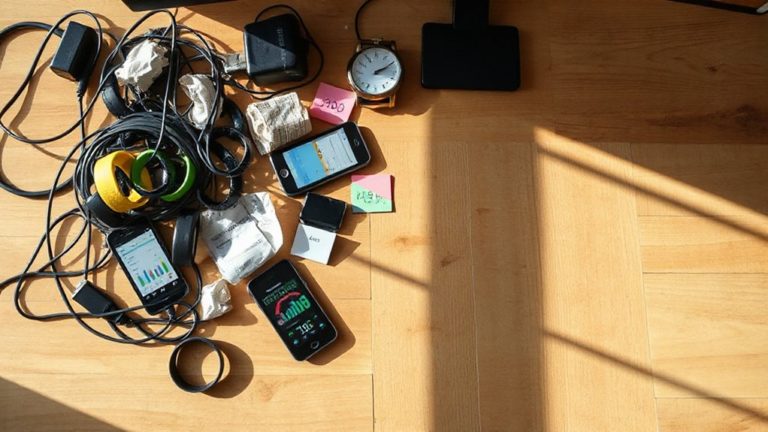








Multitasking exacts a steep cognitive price that most people fail to recognize until their productivity plummets. The brain cannot actually perform multiple tasks simultaneously; instead, it rapidly switches attention between activities, creating mental blocks that consume up to 40% of productive time. Even when people anticipate these switches, performance still suffers measurably compared to focusing on a single task.
Research reveals that heavy multitaskers consistently underperform across virtually every cognitive measure. They transcribe fewer words with lower accuracy, respond more slowly when distractions appear, and struggle with both working memory and long-term retention. Despite believing they maintain better focus, these individuals actually make more mistakes and retain less information than their single-tasking counterparts. The correlation between media multitasking and impaired sustained attention shows a medium effect size, demonstrating a meaningful relationship that extends beyond anecdotal observations.
Memory function deteriorates particularly sharply among chronic multitaskers. They experience difficulty organizing information in working memory and filtering out irrelevant stimuli, which compounds their retention problems. This pattern holds true whether researchers compare extreme groups or analyze continuous data, confirming that the relationship between multitasking habits and memory decline remains robust across methodologies.
The distraction problem runs deeper than most realize. Heavy multitaskers prove remarkably ineffective at ignoring irrelevant information, showing poor inhibitory control and increased impulsivity even when attempting single tasks. Brain imaging studies demonstrate heightened activity in frontoparietal and dorsal attention networks during task switches, indicating that the brain works harder and less efficiently when constantly shifting mental gears.
Beyond cognitive effects, multitasking triggers physiological responses including elevated stress levels, blood pressure, and heart rate, with associations to depression symptoms. Eye-tracking technology reveals that people who merely perceive themselves as multitasking show reduced engagement compared to those fully focused. The encouraging news: understanding these mechanisms empowers individuals to make better choices. By recognizing that perceived productivity gains from multitasking are illusory, people can restructure their work habits, batch similar tasks together, and create distraction-free periods that restore cognitive efficiency and enhance genuine output. Establishing simple digital boundaries like scheduled email checks and turning off non-essential notifications can further protect focus and reduce interruptions.