







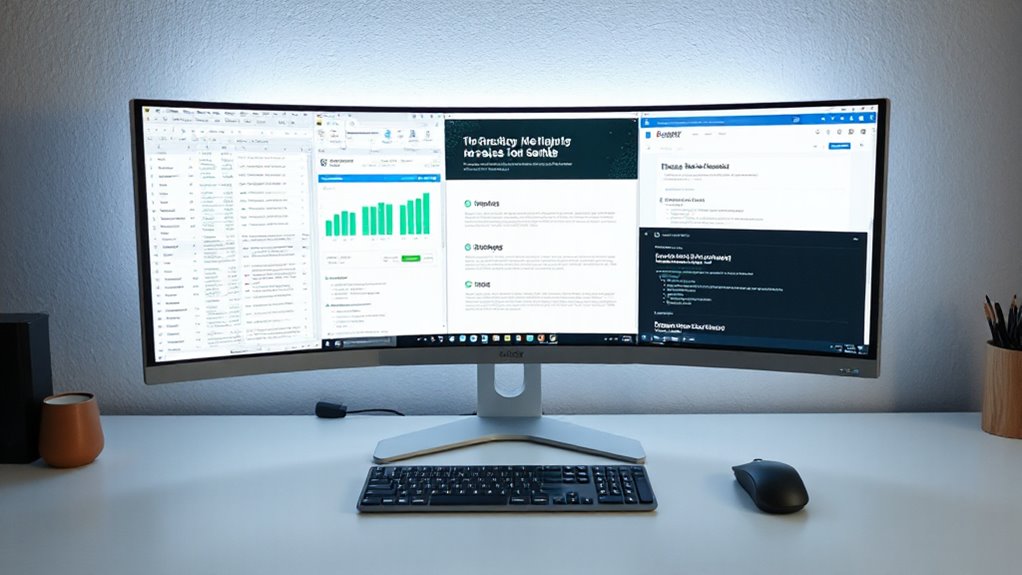
Why do some professionals seem to accomplish more in a day while appearing less stressed and more organized? The answer often lies in their workspace setup, particularly their choice to use ultrawide monitors instead of traditional single screens or even dual monitor configurations.
Research consistently demonstrates the transformative impact of ultrawide displays on workplace productivity. Dell studies show that monitors over 32 inches yield productivity gains exceeding 40%, with their UltraSharp 49 Curved model achieving improvements up to 43.8%. These findings align with University of Utah research confirming that multi-screen setups markedly enhance both effectiveness and comfort during extended work sessions. Additionally, integrating workflow optimization technologies with ultrawide monitors can further streamline task management.
The efficiency gains become particularly evident in multitasking scenarios. Ultrawide monitors enable professionals to keep multiple project aspects visible simultaneously without constant window switching, reducing the cognitive load associated with managing various applications and data sources. This capability proves especially valuable for knowledge workers who regularly juggle complex information streams throughout their workday.
Beyond productivity metrics, ultrawide monitors deliver substantial visual comfort advantages. The curved design reduces excessive eye movements while maintaining a uniform viewing distance, minimizing neck rotation compared to dual-monitor configurations. This ergonomic benefit translates to less eye fatigue during prolonged use, making extended work sessions considerably more comfortable and sustainable.
Financial considerations also favor ultrawide adoption. A single ultrawide monitor replaces multiple displays, reducing equipment costs while freeing valuable desk space and eliminating cable clutter. This streamlined approach particularly benefits modern work environments where hot desking and flexible office arrangements are increasingly common. Workstation setup is also dramatically simplified, requiring significantly less time for installation and configuration compared to complex multi-monitor arrangements.
Industry-specific applications demonstrate remarkable results. Financial traders experienced 12% productivity increases when switching from four 19-inch monitors to two 34-inch curved displays. Similarly, professionals in accounting, finance, and creative fields report the most significant benefits from ultrawide implementations.
The collaborative advantages extend beyond individual productivity. During meetings, professionals can simultaneously display diagrams alongside notes or documents, enriching team interactions through flexible information sharing. The uninterrupted visual field provided by ultrawide displays proves particularly valuable for architecture and design professionals who require comprehensive views of complex projects.
With 80% of employees believing larger screens enhance work productivity and 98% preferring multi-monitor capabilities for task tracking, ultrawide monitors represent a logical evolution in workspace optimization that addresses both current needs and future work environment trends. Integrating AI-powered task prioritization tools also complements ultrawide setups by maximizing productivity gains.
Related Posts